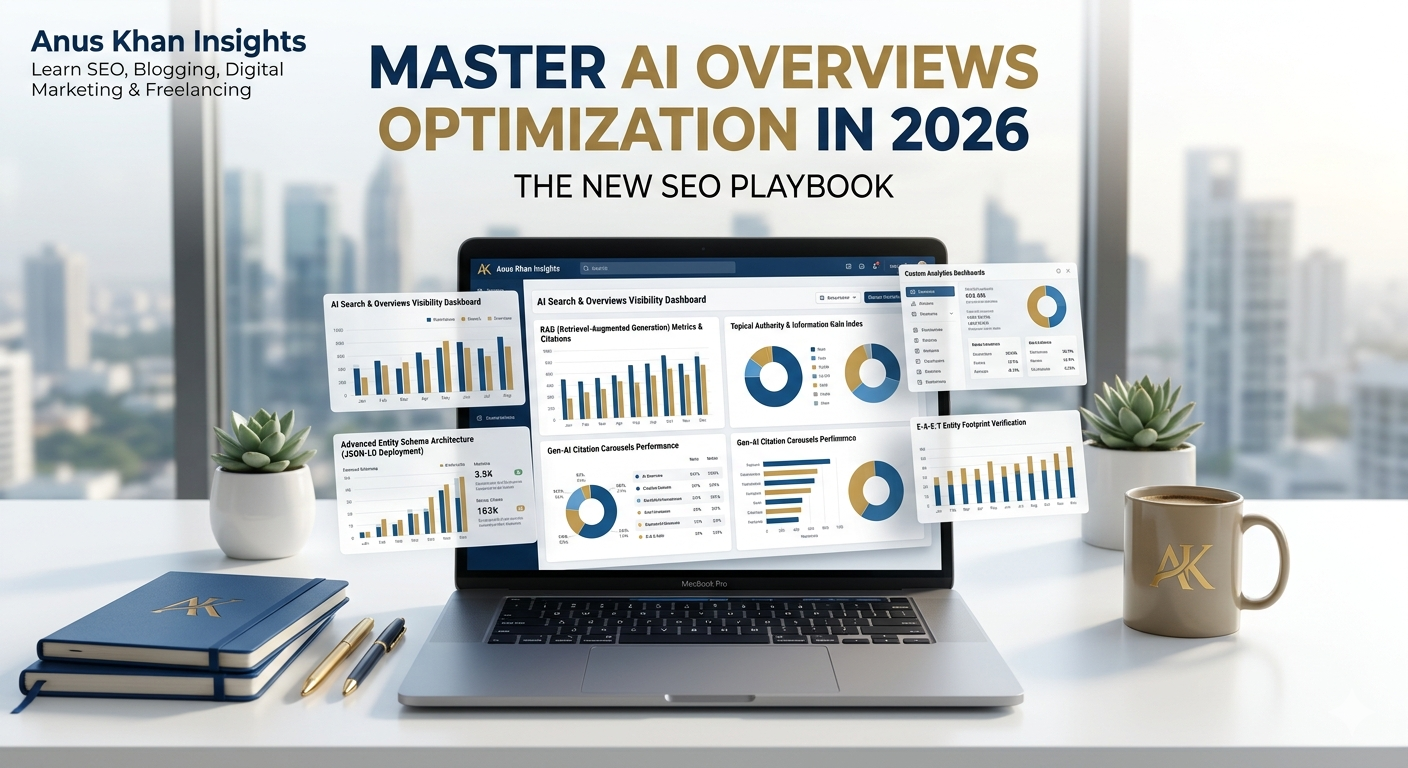
The search landscape has shifted permanently. If you are still optimizing your web pages solely for traditional blue links, you are essentially competing in yesterday’s game. Today, generative AI snapshots sit firmly at the top of almost every high-value search query, changing how users find and consume information. To protect your organic footprint and capture premium visibility, you must learn how to master AI overview optimization in 2026. At Anus Khan Insights, we don’t look at algorithmic shifts as a threat—we view them as a golden invitation to establish undeniable authority. As a platform Owner, optimizing your content to serve as the foundational source for Retrieval-Augmented Generation (RAG) engines is the ultimate playbook for modern growth. Let’s break down this new technical landscape in a clear, friendly way.
1. Prioritizing Information Gain and Unique Insights
AI engines are trained to filter out fluff. If your blog post simply repurposes the same points as the top five ranking pages, generative models will ignore your URL entirely. To land inside the coveted citation carousels of AI summaries, your content must offer high “Information Gain.”
Insert First-Hand Experience: Include original case studies, proprietary data metrics, and direct quotes from industry experts.
Avoid Generic Introductions: Cut straight to the core solution. AI crawlers look for high-density information patterns that provide immediate, unambiguous value to the user’s prompt.
2. Structuring Content for Retrieval-Augmented Generation (RAG)
LLMs (Large Language Models) do not read content the way humans do; they parse data blocks to find precise context that answers specific prompts. If your structural layout is messy, your authority gets lost in translation.
The Inverted Pyramid Text Pattern: Place your primary technical conclusion or direct answer at the absolute beginning of each section, then expand into the nuanced details below.
Conversational Q&A Heading Formats: Structure your subheadings (H3 tags) as direct, natural human questions. Follow them immediately with clean bullet points or structured markdown tables. AI models naturally favor these pre-formatted blocks when synthesising real-time overviews.
3. Building an Unshakeable Off-Page Entity Footprint
AI models do not rely exclusively on your website to verify your authority. They cross-reference information across the entire web graph to ensure an entity is genuinely trustworthy before citing it in a major summary block.
Securing Multi-Platform Co-Mentions: Ensure your brand name, Anus Khan Insights, is frequently mentioned alongside your core industry keywords across external news sites, authoritative industry forums, and digital PR distributions.
Maintaining Database Accuracy: Keep your brand profile completely uniform across global data nodes like Wikidata, official social channels, and professional registries. This unified digital footprint makes it incredibly simple for AI semantic graphs to map your platform’s niche expertise.
4. Advanced Schema Architecture for Gen-AI Crawlers
Technical on-page precision remains your backend superpower. To make your data irresistible to modern search bots, you need to use advanced structured data that explicitly defines your content’s thematic elements.
Deep Author Entity Markup: Use highly detailed
ProfilePageandPersonschema to link your authorship directly to verified digital assets, past publications, and professional profiles. This explicitly proves your real-world experience to E-A-E-T (Experience, Expertise, Authoritativeness, Trustworthiness) validation filters.Dynamic ItemList and Product Schema: When creating lists, comparative tools, or resource roundups, use nested
ItemListstructured code. Giving search bots an error-free data map guarantees your content remains fully eligible for rich, interactive AI search displays.
Conclusion
Optimizing for generative search isn’t about manipulating hidden ranking loops; it’s about becoming the most authoritative, structurally clear answer on the web. When you deliberately master AI overview optimization in 2026, you shift your digital property from a basic website into an indispensable knowledge asset. By anchoring your publishing framework around unique information gain, clean semantic structures, and flawless schema deployments here at Anus Khan Insights, you secure a massive competitive advantage. Align your technical workflows with where the future is going, build deep topical trust, and watch your platform’s digital influence scale.
Leave a Reply