Imagine this scenario: You are checking your performance data inside Google Search Console, monitoring a high-value transactional search term you’ve been targeting for months. You expect to see one primary, highly optimized landing page climbing steadily toward the first page.
Instead, you notice something strange. Your organic impressions are completely flatlining, and your average position is constantly fluctuating between page two and page four. When you dive deeper into the URL data for that exact query, you discover a shocking reality: search engine crawlers are switching back and forth between three different articles on your site, ranking one URL on Monday, a different one on Wednesday, and a third one over the weekend.
Naturally, frustration sets in. You start wondering, “Why is the search algorithm getting so confused by my content? I intentionally wrote multiple detailed guides to cover this topic comprehensively—isn’t more content supposed to give me a higher chance of ranking?”
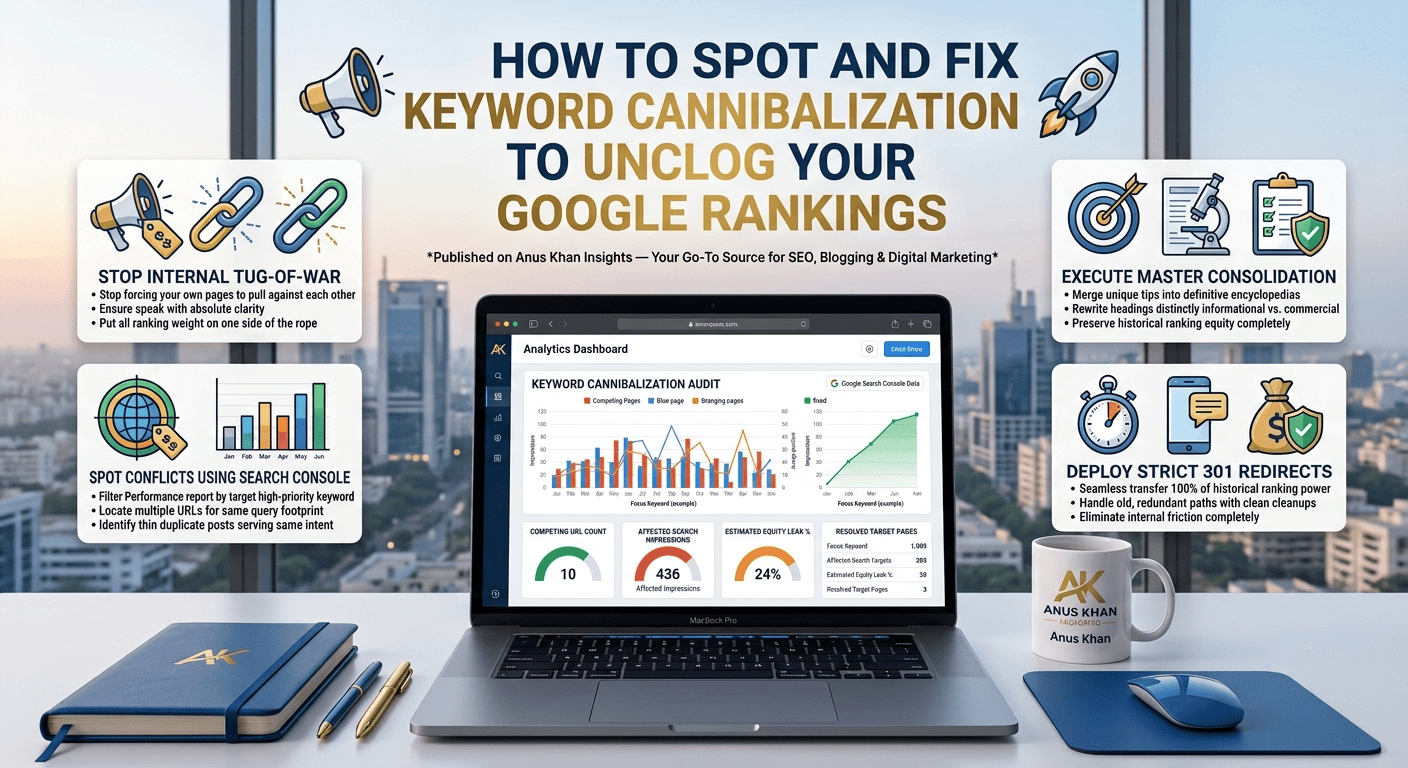
First of all, take a deep breath. At Anus Khan Insights, we want to reassure you that more content does not automatically mean more search traffic. What your platform is experiencing is a classic case of Keyword Cannibalization. This happens when multiple pages on your website target the same focus keyword and search intent. Instead of outranking your external industry competitors, you are accidentally forcing your own articles to fight each other for survival in the search results index, splitting your ranking power, internal link equity, and historical click metrics across multiple weak URLs.
In this comprehensive, step-by-step masterclass, we will pull back the curtain on advanced indexation management. We will break down exactly how to diagnose competing assets using entirely free tools and give you the precise strategic blueprints to merge, redirect, or re-optimize your pages to unclog your ranking pipelines instantly!
Let’s clean up your keyword footprint together!
The Golden Rule: The Tug-of-War Analogy
Before you open your content library to hit delete on an old post, you must understand how search bots assign authority scores. Many creators assume that writing three articles on the same topic gives them three individual tickets to the search engine lottery. In reality, it works completely against your site’s architecture.
To understand this effortlessly, let’s use our favorite Tug-of-War Analogy.
Think of ranking on the first page of search results as a highly competitive, high-stakes game of Tug-of-War against your biggest industry competitors.
A Healthy Site Structure functions like a unified, elite athletic team. Everyone stands on the same side of the rope, pulling together in perfect unison toward a single destination (this is equivalent to having One Definitive Target Page Per Search Intent).
Keyword Cannibalization is equivalent to taking half of your own team members, putting them on the opposite side of the rope, and forcing them to pull against each other. You spend all your energy, power, and muscle fighting yourself while your competitors watch from the sidelines and easily walk away with the trophy.
Your primary goal as a professional digital publisher is to put all your ranking weight on one side of the rope. You must ensure that every single URL on your domain owns a unique, distinct search intent so your site speaks to search engines with absolute clarity.
4 Steps to Diagnose and Fix Competing Content
If you want to resolve internal ranking conflicts and unlock hidden search visibility, systematically run your library through this diagnostic framework:
1. Spot Conflicting URLs Using Google Search Console
You don’t need expensive paid software suites to find structural keyword overlap. Your absolute best source of ground truth is your free search console database.
The Blueprint: Log into your dashboard and navigate to your performance report. Filter the data by a specific high-priority keyword. Next, click on the “Pages” tab directly below the main chart. If you see two, three, or more URLs accumulating impressions and clicks for that exact query during the same timeframe, you have confirmed a live cannibalization issue.
2. Group Content by User Search Intent (The Audit)
Once you locate a cluster of competing URLs, open them up side-by-side. You must determine if these pages are truly unique or if they are simply repeating the exact same core information under slightly different titles.
The Strategy: Analyze the true intent behind the content. If you have an article titled “How to Land Freelance Clients” and another titled “Freelance Client Acquisition Tips,” they share identical user intents. They are serving the same demographic at the same stage of the journey, making them prime candidates for consolidation.
3. Execute the “Master Consolidation” Strategy
If two or more pages are thin, outdated, and fighting for the same keyword space, your best move is to merge their strengths into a single, comprehensive asset.
The Action Step: Pick your strongest performing URL (the one with the highest historical search console impressions or existing backlinks) to serve as your permanent master guide. Take the unique tips, original tables, or high-value insights from the weaker competing pages and weave them naturally into the master article. Expand the text to make it the absolute definitive encyclopedia on the topic.
4. Deploy Strict 301 Redirects and Canonical Cleanups
Once your new master guide is updated and published, you must handle the old, leftover URLs carefully so you don’t lose any historical search equity.
The Pro Setup: Delete the old, redundant articles from your backend. Immediately implement a permanent 301 redirect pointing those old URLs directly to your updated master guide. This instructs search engine spiders to seamlessly transfer 100% of the historical ranking power, crawl history, and backlink equity from the deleted pages right into your primary target destination.
Keyword Cannibalization Resolution Quick-Reference Table
| Content Scenario | Algorithmic Status | Best Technical Fix | Target Outcome |
| Multiple thin posts covering the same keyword intent. | Splits domain authority; keeps all pages stuck on page 3. | Consolidate & 301 Redirect: Merge into one master asset; redirect old paths. | Maximized PageRank concentration and clear top-tier rankings. |
| An informational blog post fighting a commercial sales page. | Search crawlers display the wrong page variant to users. | De-optimize Sub-Page: Rewrite headings on the blog post to target informational “how-to” queries instead. | Clear distinction between informational traffic and conversions. |
| A sub-topic page ranking higher than your main Pillar Hub. | Broken internal link architecture and poor structural flow. | Internal Link Correction: Add a clear contextual link from the sub-page back to the hub using focus anchors. | Restored hierarchy and proper structural authority mapping. |
Final Thoughts
At the end of the day, scaling your web presence isn’t about running an automated content factory that outputs hundreds of overlapping articles—it’s about managing a clean, highly organized, and intentional digital library. When you routinely audit your search console data, identify competing keyword intentions, merge duplicate text blocks into authoritative master resources, and handle old paths with clean structural redirects, you eliminate internal friction and allow your primary pages to skyrocket directly to the top of the search index.
Let’s do a quick recap of our cannibalization cleanup action plan:
Stop forcing your own pages to pull against each other; build a unified content team.
Use your free Search Console data regularly to spot overlapping URL footprints easily.
Merge weak, duplicate articles into single, comprehensive, hyper-valuable resources.
Preserve historical ranking equity completely by utilizing clean, permanent 301 redirects.
Keep informational intents distinctly separate from commercial landing pages to avoid algorithmic confusion.
At Anus Khan Insights, we are dedicated to simplifying the operational data behind web growth. Clean up your keyword architectures systematically, optimize your intent footprints cleanly, and watch your indexing health, target impressions, and organic rankings scale!
Written by Muhammad Anus Khan — Digital Strategist, SEO Expert & Founder of Anus Khan Insights
Category: Advanced SEO & Content Library Auditing | Reading Time: 8 Minutes | Level: Advanced
Next Read: How to Run a Full Site SEO Audit in Under 60 Minutes Without Paid Tools — Coming Tomorrow on Anus Khan Insights!

Leave a Reply