Imagine this scenario: You have uncovered an incredible cluster of low-competition keywords in your niche. To save time and keep your publishing schedule consistent, you open an advanced AI text generator, type in a prompt, and watch as it spits out a 1,500-word article in under thirty seconds. It looks clean, the grammar is flawless, and it covers the basic points.
You copy the text, paste it into your WordPress editor, and publish it immediately. You do this for ten, twenty, or fifty articles, expecting a massive surge in organic impressions.
Weeks pass, and you check your tracking tools. The results are devastating. Your URLs are stuck in “Crawled – currently not indexed” limbo, or worse, your site’s overall visibility begins to decline. You run your content through an AI pattern checker, and it flags your text with a 99% probability of machine generation.
Naturally, frustration sets in. You start wondering, “Is search engine automation actively punishing me for using artificial intelligence? Do I need to completely abandon these modern tools and spend hours writing every single syllable manually just to get ranked and indexed?”
First of all, take a deep breath. At Anus Khan Insights, we want to reassure you that search engines are not inherently anti-AI. In fact, their core systems explicitly state that the method of content generation does not matter as long as the final output is helpful, original, and built for real human readers. The problem isn’t the tool you used; it’s the predictable, robotic footprint left behind by generic, unedited AI generations.
In this comprehensive, step-by-step masterclass, we will break down why raw artificial outputs trigger quality filters. We will show you the exact strategies to inject human depth, real-world utility, and unique insights into your drafts so your content stays unique, plagiarism-free, and perfectly indexable!
Let’s humanize your workflow together!
The Golden Rule: The Fast-Food Chef vs. The Gourmet Specialist
Before you touch your next prompt or outline, you must change your fundamental approach to artificial intelligence. Many creators treat AI like an independent freelance writer whom they can trust blindly. In reality, generative models function as a highly efficient prep chef.
To understand this effortlessly, let’s use our favorite Gourmet Kitchen Analogy.
Think of publishing raw, unedited AI output as running a restaurant where you simply open frozen, pre-packaged fast-food meals, heat them in a microwave, and serve them to your customers. It takes seconds to make, but the taste is generic, unoriginal, and offers no distinct nutritional value. Eventually, food critics (search bots) notice the lack of quality and stop recommending your establishment.
Conversely, think of a high-converting, humanized approach as being a Gourmet Specialist.
You use your kitchen helper (the AI) to wash the vegetables, chop the ingredients, and prepare the foundational base of the soup. But then, you step in as the master chef. You add the signature spices, adjust the seasoning based on your real-world palate, cook it to perfection, and present a signature dish that cannot be replicated anywhere else.
Your primary goal as a professional digital publisher is to use generative systems to handle structural research, while you provide the unique perspective, data-driven realness, and humanized touch that algorithms crave.
5 Steps to Make Your AI Drafts 100% Unique and Indexable
If your automated posts are failing to rank or index, systematically run your editing process through this rigorous humanization framework:
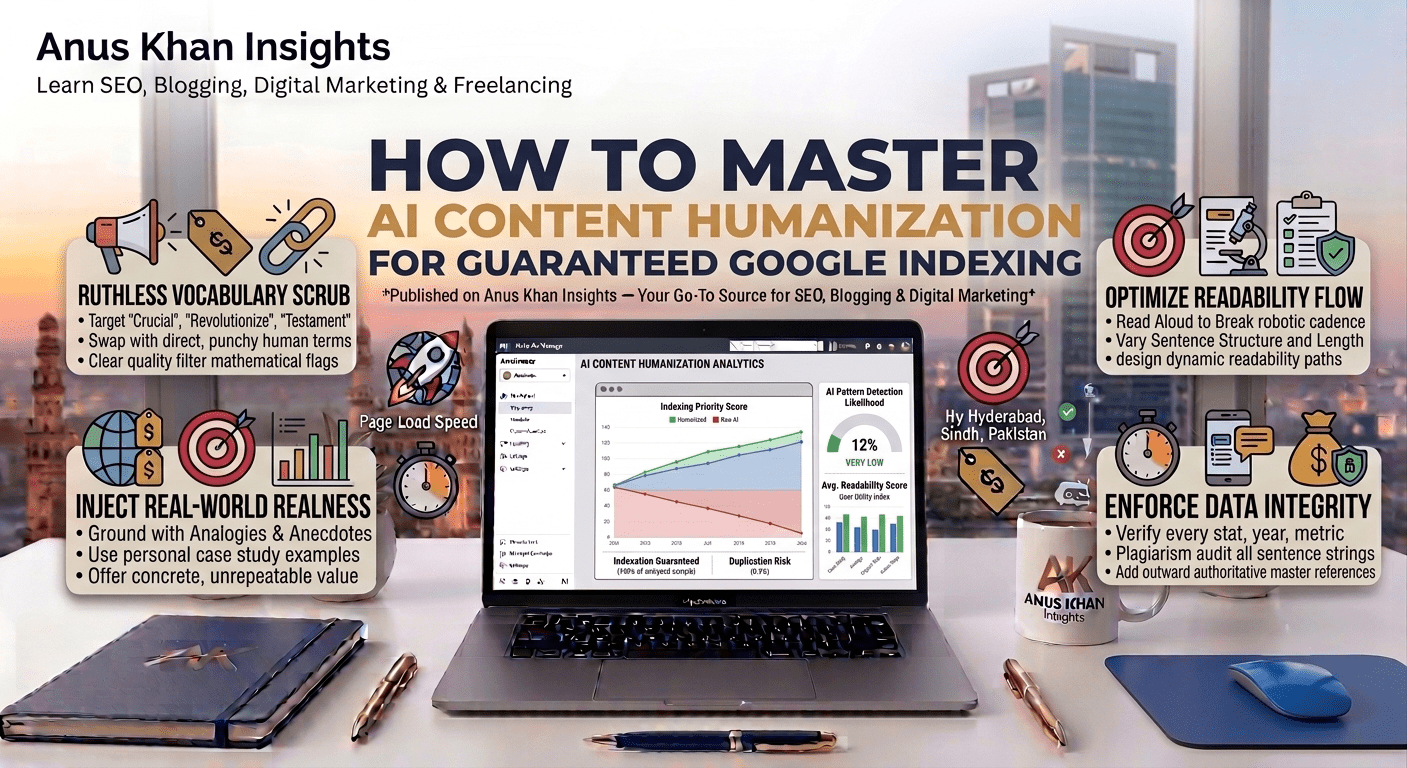
1. Ruthlessly Eradicate the “AI Vocabulary Footprint”
Large language models have specific linguistic habits and preferred vocabulary strings that they repeat constantly. Words like “Delve,” “In conclusion,” “Revolutionize,” “Testament,” “Fostering,” and “Crucial” act as immediate mathematical flags for quality filters.
The Fix: Use your text editor’s search function to find these robotic buzzwords. Swap them out for direct, punchy conversational terms. Instead of writing “It is crucial to delve into web optimization,” rewrite it naturally: “Let’s look at how web optimization actually works.”
2. Inject Real-World Analogies and Personal Anecdotes
Generative engines process historical public data, meaning they cannot invent authentic personal experiences, local context, or unique brand histories on their own.
The Blueprint: For every main section in your post, add a vivid, custom analogy or a quick case-study example. If the text explains a complex technical concept, ground it with a relatable comparison (just like our sports car or highway toll booth examples). This breaks the monotonous rhythm of machine text and provides undeniable unique value.
3. Restructure Sentences for Natural Structural Flow
Machines write with predictable patterns, often outputting sentences of identical lengths throughout an article. Humans write dynamically—mixing short, sharp statements with longer, descriptive explanations.
The Action Step: Read your text out loud. If three sentences in a row use the same structural length and cadence, break them apart. Insert a two-word punchline sentence. Use bullet points that feature varying lengths. This completely shatters the predictable code footprint.
4. Integrate Original Data, Tables, and Action Blueprints
Search engines favor high-utility documents that solve user problems quickly. Raw generative text often strings together vague, generalized advice without providing clear execution steps.
The Strategy: Turn theoretical text blocks into high-contrast quick-reference tables and structured action blueprints. If your article discusses optimization steps, build a custom comparison layout specifying variables, exact metrics, and distinct troubleshooting steps.
5. Enforce Strict Plagiarism and Fact-Checking Audits
Large linguistic models are prone to making up fake statistics or recycling identical phrasing structures used on other high-ranking websites, which can trigger duplicate text issues.
The Pro Setup: Never publish an AI draft without running a comprehensive verification audit. Cross-reference every year, metric, and case study reference against authoritative master data sources. Run the output through professional anti-plagiarism tools to ensure your sentence formulations are completely original and free of structural matches.
AI Optimization & Humanization Quick-Reference Table
| Raw AI Text Problem | Algorithmic Consequence | How to Fix and Humanize It Instantly |
| Repetitive, robotic word choices (“Delve”, “In today’s digital landscape”) | Identified as generic pattern text, leading to lower index priority. | Run a find-and-replace sweep; swap corporate fluff for raw, direct human conversational tones. |
| Identical sentence structures and lengths | Triggers automated quality filters looking for machine-generated patterns. | Read aloud to fix flow; mix short statements with detailed points to create dynamic readability. |
| Vague, generalized statements | Marked as “Low-Value Content” due to lack of distinct actionable utility. | Embed concrete case studies, original metrics, and custom diagnostic tables. |
| Hallucinated or unverified facts/stats | Destroys site trust and signals low reliability to search indexing crawlers. | Fact-check every number manually; add reliable outward references to clear authoritative checkmarks. |
Final Thoughts
At the end of the day, making your content rank and index isn’t about hiding your use of modern digital tools—it’s about upgrading those tools with authentic human craftsmanship. When you wipe away robotic vocabulary footprints, weave in custom real-world analogies, vary your readability structures, and back up every point with verifiable facts, you create a premium piece of content that search bots will gladly crawl, store, and rank at the top of their indexes.
Let’s do a quick recap of our content humanization action plan:
Treat generative tools as an efficient prep chef; you must remain the master designer of the final piece.
Scrub out predictive AI vocabulary tags and transition phrases to clear quality filters seamlessly.
Break the monotony of machine cadence by designing dynamic sentence flows and structures.
Inject authentic value parameters like original tables, step-by-step blueprints, and local context.
Maintain total data integrity by conducting exhaustive factual and originality audits before hitting publish.
At Anus Khan Insights, we are dedicated to simplifying the technical side of web growth. Humanize your publishing workflows systematically, structure your content engines cleanly, and watch your website indexing, organic reach, and target impressions scale!
Written by Muhammad Anus Khan — Digital Strategist, SEO Expert & Founder of Anus Khan Insights
Category: Content Strategy & AI Optimization | Reading Time: 8 Minutes | Level: Intermediate
Next Read: How to Build an Advanced Semantic Content Map to Dominate High-Competition Niches — Coming Tomorrow on Anus Khan Insights!




Leave a Reply