Imagine this scenario: You have successfully built a handful of high-quality, authoritative backlinks to your site’s primary case study or home page. Your overall domain metric climbs, and that specific linked page starts ranking well.
However, when you look at your actual informational articles—the fresh tutorials and transactional landing pages you deployed last month—they are completely stagnant. They barely register impressions, and some haven’t even been discovered by search crawlers yet.
Naturally, frustration sets in. You look at your site structure and think, “Why isn’t my hard-earned link authority lifting the rest of my website? Do I really need to go out and manually build hundreds of expensive external links to every single individual blog post just to make them rank?”
First of all, take a deep breath. At Anus Khan Insights, we want to reassure you that your domain’s existing authority is already strong enough to lift your entire platform. The problem isn’t a lack of overall power; it’s an internal structural block. When external sites link to your high-value assets, they deposit an algorithmic currency known as PageRank or link equity into that specific URL. If your website’s internal architecture is messy, disconnected, or lacks clear paths, that powerful ranking equity gets trapped on a single page, evaporating instead of fueling your entire index.
In this comprehensive, step-by-step masterclass, we will pull back the curtain on advanced crawl equity distribution. We will break down exactly how modern search engines calculate the flow of internal link value and give you the definitive architectural checklist to unlock your site’s hidden power and skyrocket your organic visibility!
Let’s engineer your site’s structure together!
The Golden Rule: The Agricultural Irrigation Analogy
Before you open your site backend to drop a random link into an old post, you must change how you visualize your blog’s layout. Many publishers view links simply as clickable navigational paths for human readers. In reality, modern search engine bots treat your links as highly functional conduits for authority.
To understand this effortlessly, let’s use our favorite Agricultural Irrigation Analogy.
Think of your external backlinks as a massive, powerful rainstorm that fills up a centralized Water Reservoir at the top of a hill (this is your High-Authority Landing Page or Home Page).
If you build no channels or pipelines leading down the hill, the water stays trapped in the reservoir. The crops at the bottom of the hill wither, dry up, and die due to complete neglect (this is equivalent to having Orphan Pages and Poor Internal Linking).
Conversely, if you dig a beautiful, highly strategic Irrigation Grid of clear, connected pipelines, the water flows smoothly and evenly down into every single crop bed, nourishing every individual plant and causing your entire farm to bloom rapidly.
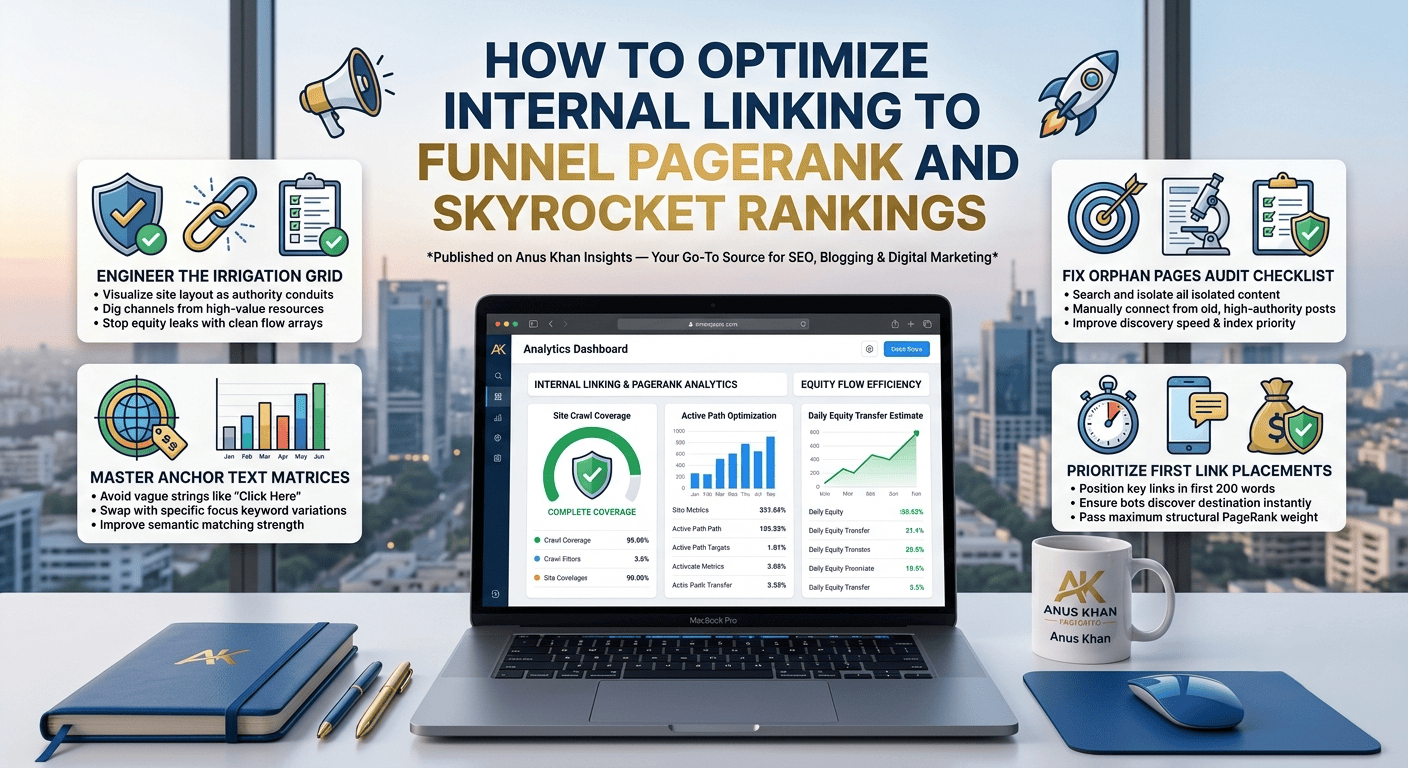
Your primary goal as a professional search strategist is to design an internal linking irrigation grid. You must funnel the link equity sitting on your highest-performing assets directly down into your deep informational sub-pages.
5 Core Steps to Optimize Your Internal Link Architecture
To clean up your authority pipelines and ensure every page on your domain receives maximum ranking power, systematically run your architecture through this optimization framework:
1. Reclaim Power from Dead Ends and Low-Value Nodes
Many creators make the mistake of linking heavily out to external websites or low-value administrative pages from their core articles without balancing the flow. This causes your internal equity to spill out into dead ends.
The Action Step: Audit your primary body copy. Ensure your articles are not leaking authority unnecessarily. Keep your internal links focused on high-priority informational clusters. If you must link to external references, ensure they open in new tabs and use natural contextual balances so search bots spend more time crawling your internal structure.
2. Formulate Exact, High-Relevance Anchor Text Matrices
Using generic anchor texts like “Click here,” “Read more,” or “This post” completely wastes an internal link’s potential. Search algorithms use anchor text to understand the exact semantic context and topical relevance of the target page before they arrive.
The Blueprint: Use descriptive, keyword-rich variations as your anchor text. Instead of writing, “To learn about content humanization, click here,” structure your phrase naturally: “To scale your indexation priority, you must learn how to humanize AI content.” This provides clear mathematical instructions to crawler systems.
3. Build Direct Bridges to Rescue “Orphan Pages”
An orphan page is an article that is live on your server but has zero internal inbound links pointing to it from any other post on your site. Because crawl bots follow links to find pages, an orphan page is effectively invisible to search engines and will never index or rank.
The Fix: Use site auditing software to search for pages with zero internal links. Once identified, go into your older, highly authoritative articles that share a similar topic and naturally embed a contextual link pointing straight to the missing page. This immediately brings the isolated page back into the crawl loop.
4. Link Upward, Downward, and Laterally Within Clusters
To make your semantic content clusters bulletproof, your linking structures must mirror your structural hierarchy perfectly.
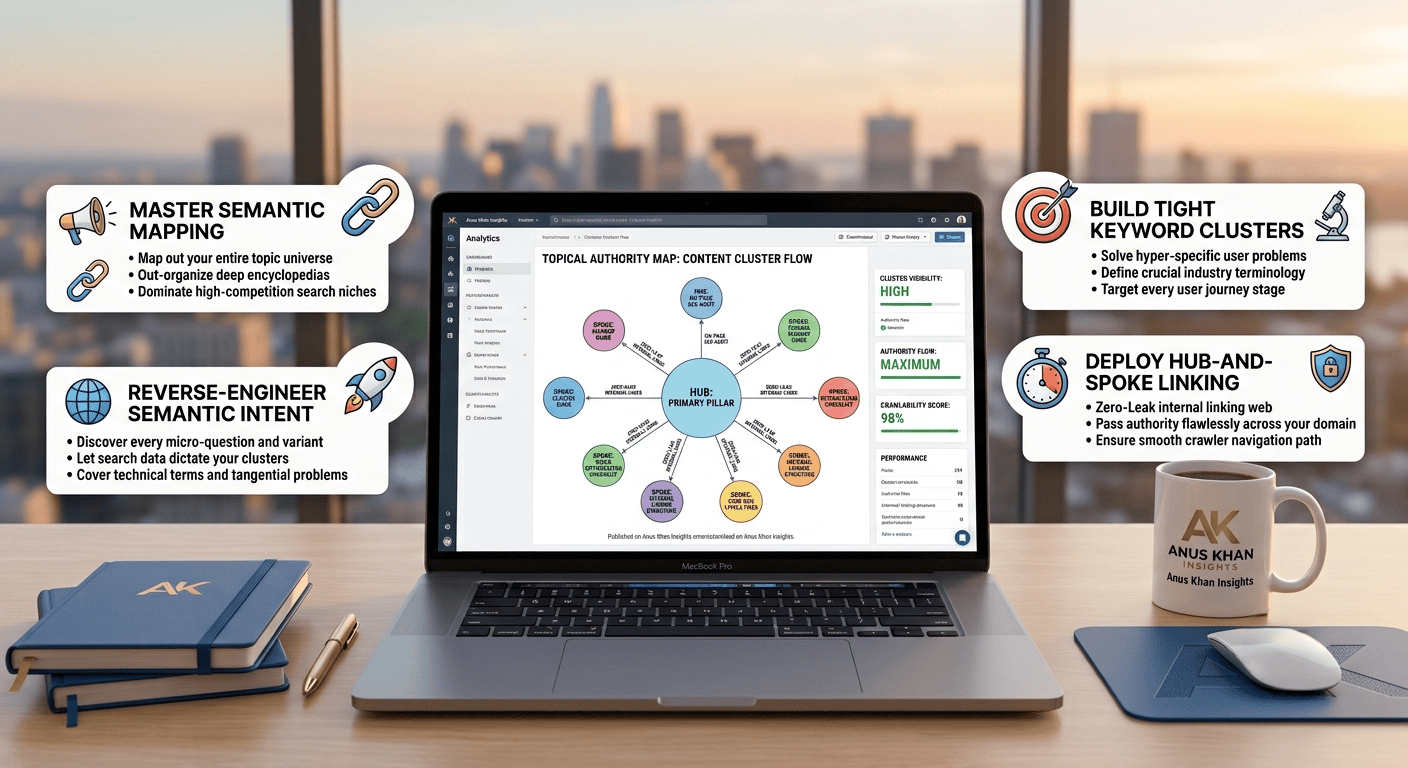
The Strategy: Always practice strict internal routing. Your granular sub-articles must link upward to your main pillar hub. Your main pillar hub must link downward to individual sub-pages. Finally, your sub-articles should link laterally to adjacent sibling posts within the same category to provide a comprehensive, zero-leak navigation web for both users and crawlers.
5. Prioritize “First Link” Contextual Placements
Search algorithms do not weigh every link on a page equally. Links embedded at the top of an article’s body text naturally pass significantly more authority and receive vastly higher click-through metrics than links buried deep inside a site’s footer layout.
The Pro Setup: Place your most important internal links—the ones leading to your high-converting target landing pages—within the first 200 words of your article. This ensures search engines discover your high-priority destinations instantly during their initial parsing pass, assigning them maximum structural weight.
Internal Linking & Link Equity Quick-Reference Table
| Architectural Status | Algorithmic Impact | Immediate Action Plan | Target Outcome |
| Orphan Pages Present | Complete index failure; hidden content assets. | Conduct a site audit; link to them from your top 3 authoritative pages. | Complete crawl coverage and guaranteed indexing. |
| Vague Anchor Texts (“Click Here”) | Diluted keyword relevance and weak semantic matching. | Swap out lazy text strings for clear, descriptive focus keyword variations. | Enhanced keyword rankings and clear contextual mapping. |
| Deep Footprints (4+ Clicks Away) | Crawl budget waste; equity drops off before reaching the page. | Move links up the site architecture; add them into main category hub menus. | Improved page discovery speed and higher index priority. |
| Broken Internal Links (404s) | Trapped PageRank; disrupted user and crawler paths. | Repair or redirect all internal dead links to live, relevant alternatives. | Zero equity leaks and clean structural health. |
Final Thoughts
At the end of the day, maximizing your search rankings isn’t always about racing to build more external backlinks—it’s about maximizing the raw power your domain already possesses. When you clear out dead-end leaks, optimize your anchor text phrases thoughtfully, rescue your orphan pages, and place your key internal links high up within your body text, you turn your blog into a high-performance ranking asset.
Let’s do a quick recap of our internal linking optimization action plan:
Visualize your site structure as an irrigation grid designed to distribute authority smoothly.
Use precise, keyword-descriptive phrases for all internal anchors to maximize contextual signal strength.
Audit your index regularly to rescue orphan pages and pull them back into the crawl cycle.
Maintain clear upward, downward, and lateral pathways across all content clusters.
Position your highest-value internal links early in your body copy to pass maximum structural weight.
At Anus Khan Insights, we are dedicated to simplifying the operational architecture of web growth. Map your internal pipelines systematically, structure your linking arrays cleanly, and watch your crawl health, keyword rankings, and organic authority scale!
Written by Muhammad Anus Khan — Digital Strategist, SEO Expert & Founder of Anus Khan Insights
Category: On-Page SEO & Site Architecture Optimization | Reading Time: 8 Minutes | Level: Advanced
Next Read: How to Use Free Search Console Data to Spot Hidden PageRank Chokepoints — Coming Tomorrow on Anus Khan Insights!

Leave a Reply