Imagine this scenario: You have found a list of highly profitable keywords with massive search volumes. You spend days writing a comprehensive, beautifully structured master guide targeting the primary keyword. You optimize the headings, add clear tables, embed relevant images, and ensure the text reads naturally.
You publish it, request indexing, and wait for it to climb the rankings.
Months pass, and your page is completely stuck outside the top ten search results. Meanwhile, a legacy competitor ranks in the top three with an article that is shorter, less detailed, and hasn’t been updated in over a year. You run a backlink check and notice they don’t even have many external links pointing to that specific URL.
Naturally, frustration sets in. You start wondering, “Why is the search algorithm favoring an inferior piece of content over my exhaustive guide? What secret structural advantage do they have that allows them to maintain a total monopoly over this niche?”
First of all, take a deep breath. At Anus Khan Insights, we want to reassure you that the algorithm isn’t broken, nor is it playing favorites. What your website is running into is the wall of Topical Authority. Search engines no longer evaluate web content as isolated, individual pages. Modern semantic algorithms look at the entire footprint of your website. If a competitor has written fifty interconnected articles covering every micro-angle of a topic, the algorithm treats them as a trusted expert. If you have only written one standalone guide, you are treated as a casual observer.
To win the rankings war in modern SEO, you must stop publishing random, disconnected articles. You need to deploy a structural semantic content map that proves to search crawlers that you own the entire topic from top to bottom.
In this comprehensive, step-by-step masterclass, we will pull back the curtain on advanced semantic SEO. We will break down exactly how search bots judge topical expertise and give you the precise blueprint to build a high-performance topical authority map that commands top rankings.
Let’s organize your content engine together!
The Golden Rule: The Encyclopedia vs. The Magazine
Before you map out your next content silo or cluster, you must understand how modern semantic search engines categorize information. Many bloggers approach content creation like a daily lifestyle magazine—publishing an article about link building on Monday, an article about AdSense on Wednesday, and a freelance tip on Friday. This scattered approach destroys your authority profile.
To understand how to fix this effortlessly, let’s use our favorite Library Classification Analogy.
Think of search engine crawlers as a chief university librarian organizing a massive research wing.
If a local publisher hands them a miscellaneous collection of scattered essays containing one article on tech, one on cooking, and one on finance, the librarian will drop it into a general reference bin where it rarely gets discovered (this is equivalent to a Low-Authority, Unorganized Blog).
Conversely, if a specialist publisher walks in and hands the librarian a pristine, multi-volume Specialized Encyclopedia that systematically maps out every sub-topic, definition, variant, and case study within a single field—perfectly cross-referenced—the librarian will instantly put it on the front display shelf as the definitive resource.
Your primary goal as a professional digital publisher is to build a digital encyclopedia. You want to cover a specialized topic so thoroughly that a search engine has no choice but to route industry search traffic directly through your domain.
The 4 Steps to Map Out Total Topical Authority
If you want to break through ranking plateaus and establish absolute topical dominance, systematically run your content planning through this rigorous semantic mapping framework:
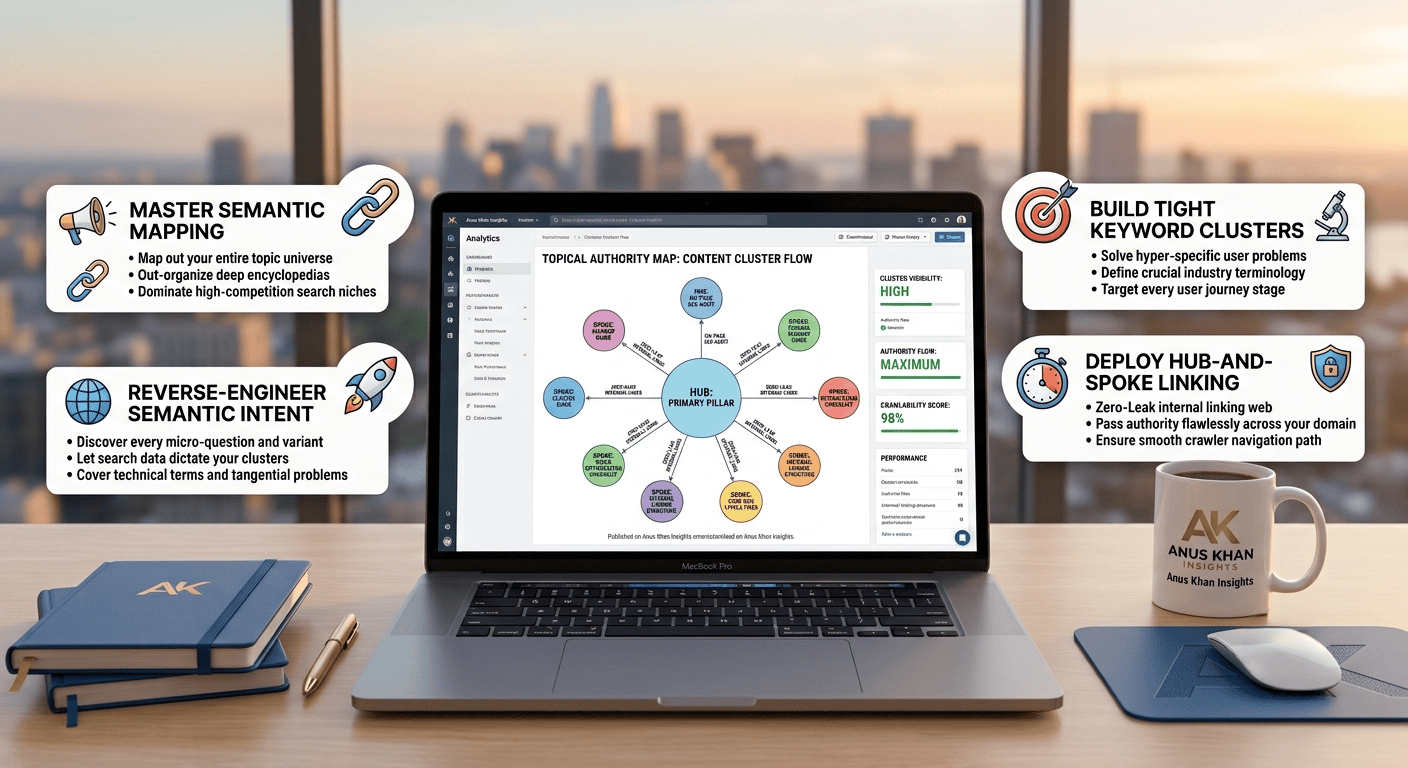
1. Identify Your Core Topical Pillar
The foundation of a topical map starts by defining your primary macro-topic. This is the main high-volume keyword category that you want your brand to be universally trusted for across the web ecosystem.
The Blueprint: Pick a macro category that directly aligns with your core business or monetization model (e.g., On-Page SEO Audit or Freelance Client Acquisition). This core pillar will serve as the central hub page of your entire cluster, designed to link out to all supporting sub-articles.
2. Reverse-Engineer the Semantic Sub-Topics
Once your central pillar is set, you must uncover every single micro-question, technical term, and tangential problem a user might have regarding that topic. Do not rely on basic guesswork; let search data dictate the map.
The Strategy: Use search variations, look at the “People Also Ask” blocks, and analyze competitor indices to break your pillar into secondary and tertiary sub-topics. If your main pillar is Link Building, your sub-topics must include Broken Link Identification, Anchor Text Optimization Matrices, Outreach Email Calibration, and Resource Page Pitching.
3. Build Tightly Knit Keyword Clusters
To prevent your articles from competing against one another in search results (keyword cannibalization), group your discovered terms into distinct keyword clusters. Every unique search intent requires its own dedicated post.
The Action Step: Organize your content calendar so that each article targets a highly specific sub-intent. Ensure that you have a comprehensive definition post for beginners, practical step-by-step optimization tutorials for practitioners, and advanced diagnostic checklists for professionals. This ensures your site addresses every stage of the user journey.
4. Deploy a Zero-Leak Internal Linking Web
The true magic of topical authority lies entirely within your internal linking architecture. Links act as pathways that pass authority and contextual relevance seamlessly across your entire domain.
The Pro Setup: Use a strict Hub-and-Spoke Linking Model. Every supporting sub-article (spoke) must link directly back to the main pillar page (hub) using clean, contextual anchor text. Furthermore, supporting articles within the same cluster should link laterally to one another where relevant. Never let a page sit as an isolated island; ensure search bots can crawl your entire cluster smoothly in a single pass.
Semantic Architecture & Cluster Quick-Reference Table
| Architectural Component | Strategic Function | Linking Directives | Target Metrics |
| Pillar Hub Page | Serves as the macro authority anchor; covers the topic broadly. | Receives inbound links from all sub-pages; links out to core spokes. | High-volume head terms; broad category rankings. |
| Supporting Spoke Post | Solves a hyper-specific user problem or micro-intent. | Links back to the main Hub page and connects to adjacent spokes. | Long-tail variations; high-intent transactional search. |
| Definitional Node | Defines crucial industry terminology or basic concepts. | Links upward to relevant spoke guides to provide deep context. | Navigational search; informational snippet blocks. |
| Case Study Asset | Proves execution and provides original data metrics. | Links outward to support technical statements across the hub network. | Editorial natural backlinks; brand trust signals. |
Final Thoughts
At the end of the day, dominating high-competition search niches isn’t about trying to out-spend your competition on premium link acquisitions—it’s about out-organizing them through deep structural authority. When you stop writing random blog posts, map out your semantic sub-topics comprehensively, cluster your keyword intents accurately, and connect your pages through a zero-leak internal linking web, you establish an unbeatable topical footprint that search engines trust completely.
Let’s do a quick recap of our topical authority action plan:
Transition your website from a generic digital magazine into a specialized, deep encyclopedia.
Select clear macro pillars that form the foundation of your site’s monetization and business goals.
Deconstruct your main topics into every possible user query and intent variant.
Keep your content clean and indexable by organizing search terms into distinct keyword clusters.
Pass authority flawlessly across your domain using the strict Hub-and-Spoke internal linking model.
At Anus Khan Insights, we are dedicated to simplifying the structural side of web growth. Map your content universes systematically, structure your semantic architectures cleanly, and watch your topical authority, search engine trust, and keyword rankings scale!
Written by Muhammad Anus Khan — Digital Strategist, SEO Expert & Founder of Anus Khan Insights
Category: Advanced SEO & Semantic Content Mapping | Reading Time: 8 Minutes | Level: Advanced
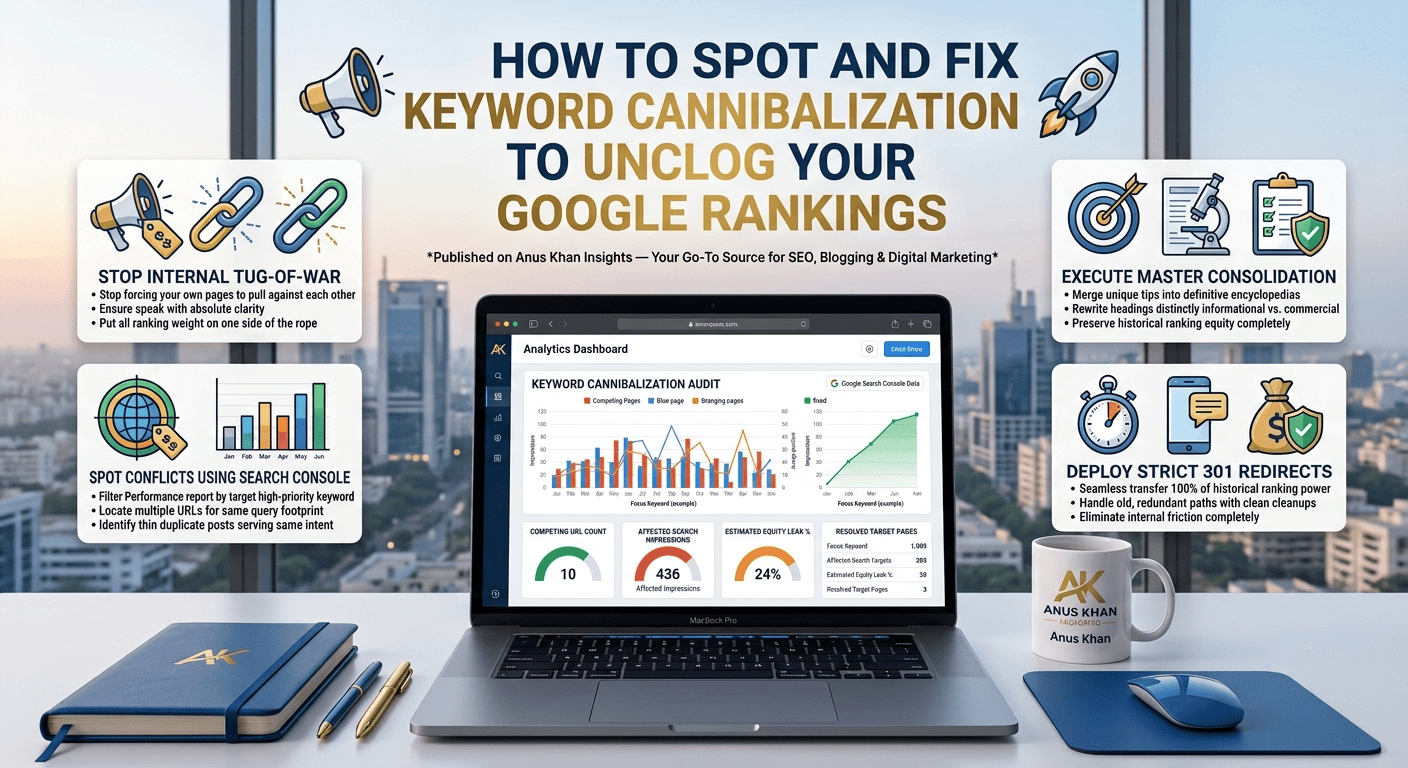
Next Read: How to Spot and Fix Toxic Keyword Cannibalization in Under 15 Minutes — Coming Tomorrow on Anus Khan Insights!

Leave a Reply