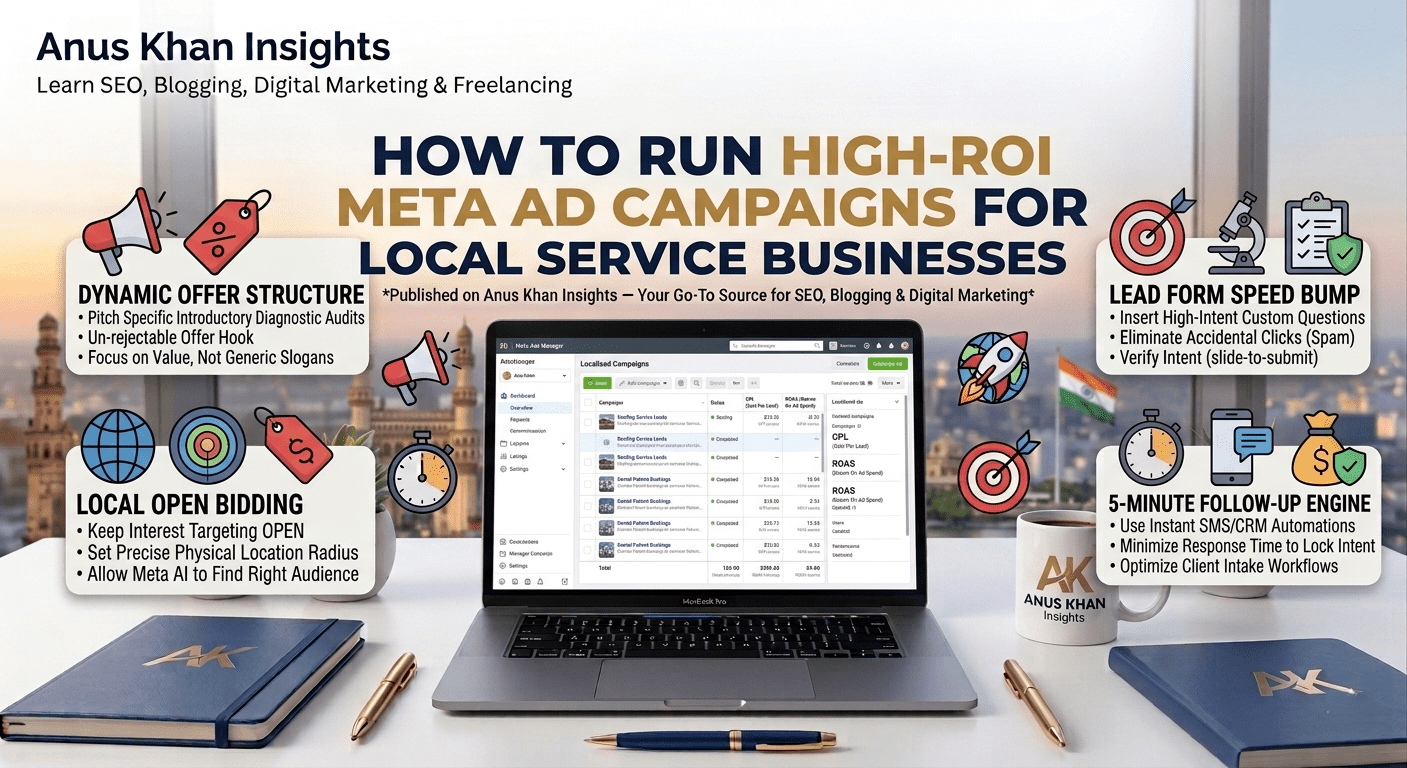
Imagine this scenario: You finally convince a local client—perhaps a premium roofing company, a high-end interior designer, or a private medical practice—to allocate a $1,000 monthly ad budget to Facebook and Instagram. You set up a clean, creative banner, pick their city location, write a nice caption, and confidently hit the “Publish” button inside the Ads Manager.
A few days pass, the budget is being spent fast, and your client checks their dashboard. The ad has generated thousands of impressions and hundreds of clicks, but when the client checks their office intake log, there are exactly zero new customer phone calls or leads.
Naturally, panic sets in. The client calls you up furiously, saying, “Facebook ads don’t work for my business. You are burning my money!” You look at the vanity metrics—the likes, shares, and comments—and wonder, “Why aren’t these clicks converting into actual high-paying customers? What am I missing?”
First of all, take a deep breath. At Anus Khan Insights, we want to reassure you that this is the exact roadblock encountered by 90% of digital marketers running local paid acquisition. It does not mean Meta ads are dead for brick-and-mortar services, and it certainly does not mean your creatives are bad. It simply means you are optimizing for the wrong objective, failing to combat ad fatigue, or using weak offer structures that fail to capture real-world intent.
In this comprehensive, step-by-step masterclass, we will pull back the curtain on Meta’s bidding auction machine. We will analyze the underlying mistakes behind failed local ad spend and show you the exact technical frameworks to run high-ROI Meta ad campaigns that pack your clients’ calendars with paying appointments.
Let’s build a profitable ad engine together!
The Golden Rule: The Lead Quality Filter vs. The Cheap Click Trap
Before you toggle a single button inside Meta Ads Manager, you must understand how the algorithm optimizes its audience distribution. The biggest mistake beginners make is selecting the “Traffic” objective because it delivers the cheapest clicks.
To understand this effortlessly, let’s bring back our favorite Nightclub Analogy.
Think of the Meta ad auction as a massive, bustling nightclub. The “Traffic” objective instructs the security bouncer to grab anyone standing on the street who looks like they enjoy peering through windows, dragging them into your club. Your venue looks packed with people (high clicks), but nobody is buying premium drinks at the bar (zero sales).
Conversely, the “Leads” or “Conversions” objective instructs the bouncer to specifically scout the VIP lounges of the city for individuals holding active credit cards who are explicitly looking to purchase premium bottle service right now. They cost a bit more to bring through the door, but they actually spend money at the cash register.
If you optimize your local service ads for “Traffic” or simply hit the lazy “Boost Post” button on a page layout, you are filling your client’s site with window shoppers. Your primary goal as a professional digital strategist is to optimize for native Lead Objectives and deploy data collection filters that isolate high-intent buyers.
4 Pillars of a High-Converting Local Meta Ad Campaign
If your paid campaigns are burning budgets without generating trackable client revenue, implement this bulletproof local structural framework immediately:
1. Structure a No-Brainer Dynamic Offer
In local service marketing, your creative and copy are only as good as the underlying offer. If your ad text says, “We provide quality plumbing services, call us,” you will fail. Premium clients need an immediate, low-friction reason to break their pattern and engage.
The Tactic: Package an irresistible diagnostic or introductory asset. For an HVAC company, pitch a “$49 Pre-Summer AC Safety & Performance Audit” instead of a vague discount. For a premium dental clinic, offer a “Complete New Patient Smile Evaluation + Free X-Rays.”
2. Ditch Hyper-Targeting (Embrace Local Open Bidding)
Many marketers ruin their local campaigns by stacking 15 different interest keywords (like targeting people who like “home improvement,” “roofs,” and “architecture” simultaneously). In a restricted local geographic radius (e.g., 15 miles around a business zip code), interest layering makes your target audience size dangerously small, driving your CPM costs through the roof.
The Blueprint: Keep your interest targeting completely Open. Set the exact physical location parameters (e.g., Radius: 15 miles), specify the age bracket (e.g., 30–55 for homeowners), and let your ad creative and headline do the targeting naturally. Meta’s AI algorithm updates are smart enough to look at your text and automatically find the right consumers.
3. Deploy the Native Lead Form with a “Speed Bump”
To get the highest conversion rates, utilize Meta’s Native Instant Forms rather than redirecting users to a slow external website page. However, native forms can sometimes attract accidental or low-quality submissions.
The Fix: Insert a custom Higher Intent “Speed Bump.” Add a mandatory custom question that cannot be autofilled by Facebook.
Example: For a roofing contractor, ask: “Are you the legal owner of the property? (Yes/No)” or “What is the main issue with your roof? (Leaking / Old Age / Storm Damage).” This forces the user to pause, type, and verify their intent, instantly wiping out spam submissions.
4. Execute the 5-Minute Follow-Up Engine
The ROI of a local service ad campaign is determined entirely by lead response time. A lead generated via a Facebook ad is a casual micro-moment; if you wait 4 hours or a full day to call them back, their intent drops to zero,o and they will completely forget who you are.
The Solution: Use software automation (like Zapier) to instantly bridge your Meta Lead Form to an automated SMS dashboard or your client’s CRM. The absolute second a user hits submit, an automated text message should hit their phone: “Hey [Name], saw you just requested our $49 AC Performance Audit! Do you prefer a morning or afternoon slot this week?”
Paid Acquisition Performance & Audit Quick-Reference Table
| Metric Warning | What It Truly Means | How to Fix It Fast |
| High CTR, but Zero Leads | Your ad creative and offer hook are highly appealing, but your lead form or landing page setup has too much friction. | Shorten your lead form questions; ensure the headline on your form matches the exact promise made in the ad image. |
| Painfully High Cost Per Lead (CPL) | Your geographic radius is too narrow, or your ad creative has triggered local audience fatigue. | Broaden your physical location radius; launch 3 fresh ad creative variations utilizing real consumer transformation photos. |
| Leads complain: “I never filled this out” | You are using the “More Volume” form setting with pure auto-fill fields, leading to accidental clicks. | Toggle your ad settings to “Higher Intent” and add a slide-to-submit verification screen at the end of the form. |
| High Lead Volume, Low Close Rate | Your digital targeting is working flawlessly, but the client’s internal sales team is failing to call leads back quickly. | Audit the client’s intake timeline. Ensure leads are being phoned within 5 minutes of form completion. |
Final Thoughts
At the end of the day, launching high-ROI paid campaigns on Meta isn’t about uncovering secret technical algorithmic hacks—it’s about matching an un-rejectable offer with clean, localized positioning and an instantaneous internal conversion workflow. When you master this balance, you transition from a risky marketing expense into your client’s most valuable revenue asset.
Let’s do a quick recap of our diagnostic action plan:
Always optimize local acquisition for the Lead or Conversion objective; avoid basic Traffic campaigns.
Lead your campaigns with high-value, specific introductory diagnostic offers instead of generic slogans.
Keep your local geographic interest targeting open; let Meta’s AI locate your audience based on creative relevance.
Incorporate higher-intent custom speed-bump questions within your native forms to filter out low-value submissions.
Bridge your lead capture tools directly to instant SMS follow-up engines to lock in short client response times.
At Anus Khan Insights, we are dedicated to simplifying the technical side of web growth. Build your ad campaigns strategically, manage your client dashboards systematically, and watch your local paid retainers scale!
Written by Muhammad Anus Khan — Digital Strategist, SEO Expert & Founder of Anus Khan Insights
Category: Paid Advertising & Meta Ads | Reading Time: 8 Minutes | Level: Advanced
Next Read: How to Track Offline Conversions to Prove Accurate Meta Ads ROI — Coming Tomorrow on Anus Khan Insights!
Leave a Reply