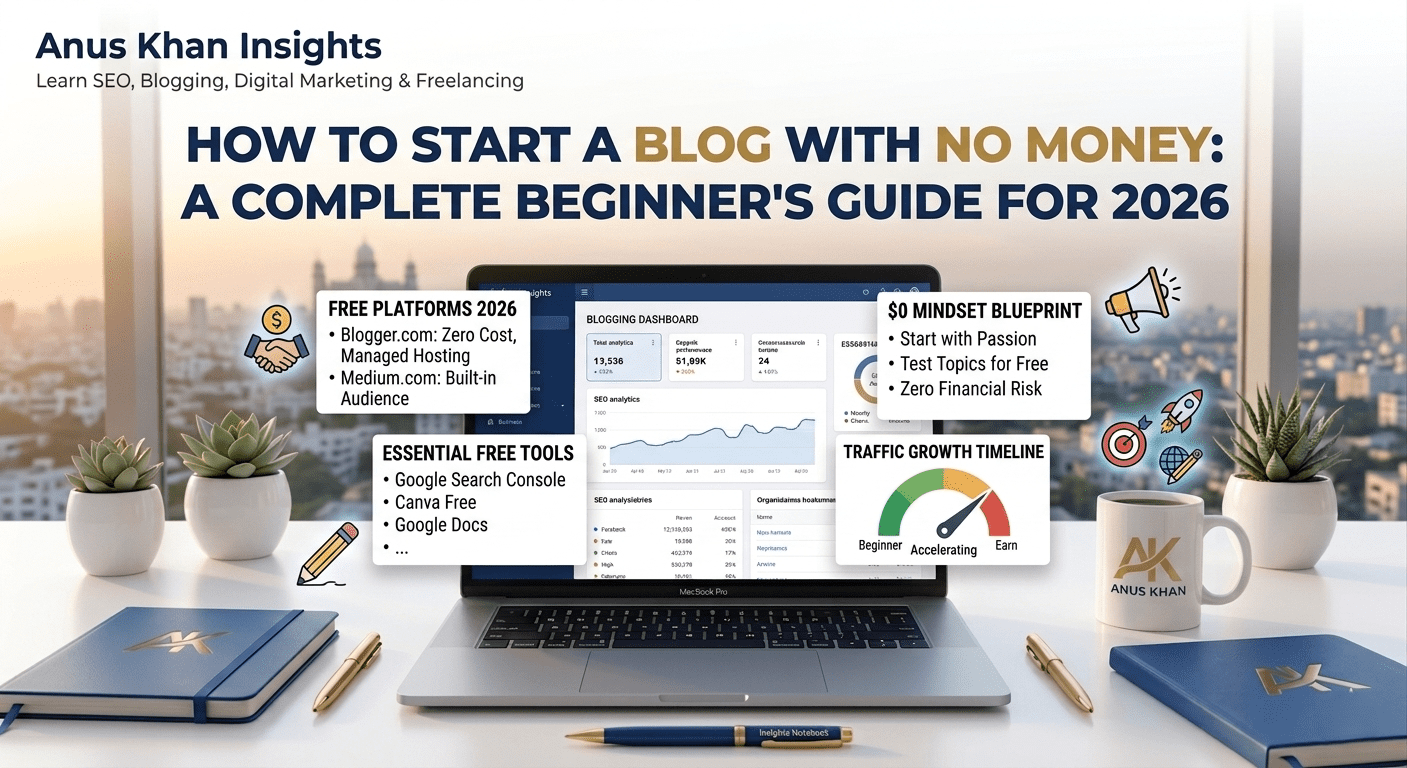
Have you ever wanted to start your own online business, share your unique ideas with the world, but stopped completely the moment you looked at the price of premium hosting and domain names?
You are definitely not alone.
There is a massive myth floating around the digital world that building a successful blog requires thousands of dollars, premium plugins, and high-end private servers. But in 2026, that landscape has changed entirely. Today, launching a professional, high-performing blog with zero financial investment is not just a dream — it is a highly practical reality.
In this beginner-friendly blueprint by Anus Khan Insights, we will break down the exact step-by-step process to start your blogging career with an absolute zero budget. If you have a smartphone or a laptop and a stable internet connection, you already have everything you need to become a successful creator.
Let’s dive straight in!
Why Starting with No Money is Your Secret Advantage
When you start a business with no money, most people see it as a major disadvantage. In the world of blogging, however, a zero budget can actually become your greatest competitive strength.
Look at it this way: If you spend thousands of rupees on premium hosting, customized themes, and expensive keyword research tools on day one, you immediately place an immense amount of financial pressure on your shoulders. This stress makes you worry about making money from your very first week. This exact anxiety is why most beginner bloggers burn out, lose patience, and quit within their first 30 days.
When you launch a free blog:
You face zero financial risk and have nothing to lose.
You gain the total freedom to experiment, find your writing voice, and test topics without bills hanging over your head.
Your entire focus goes where it actually matters — writing incredible, helpful content for your readers instead of tweaking complicated technical code.
Step 1: Find Your “Sweet Spot” Niche (The Free Way)
A “niche” is simply the specific topic or core subject your blog will focus on. The single biggest mistake new bloggers make is attempting to write about everything all at once. One day they write about tech updates, the next day about sports, and the day after that about cooking recipes.
This completely confuses search engine algorithms like Google, and it keeps you from building a loyal, recurring reader base. To build true authority online, you must find your Sweet Spot.
To discover your niche for free without buying expensive premium database tools, ask yourself these three simple questions:
What am I naturally passionate about? What is a topic you can comfortably talk about for hours with your friends without getting bored?
Can I write 30 to 40 articles on this topic? If the answer is yes, you have found a sustainable subject.
Are people actively searching for this online? Go to Google, type your topic, and look closely at the “People Also Ask” section. If you see real questions listed there, it means a hungry audience is already waiting for your answers.
At Anus Khan Insights, we always recommend narrowing down your topic. Don’t just write about “Fitness”; write specifically about “Home Workouts for Busy Professionals.”
Step 2: Choose Your 100% Free Blogging Platform
You do not need to buy a .com domain extension or a monthly web server subscription to start publishing your thoughts online. In 2026, two incredibly powerful, stable platforms will allow you to build an audience completely free of charge.
1. Blogger.com (The Reliable Workhorse owned by Google)
Blogger is a free platform managed directly by Google. It has been a staple of the web for decades and remains one of the safest training grounds for new bloggers.
The Pros: It is 100% free for life. Because it lives on Google’s own servers, your website will rarely crash, and your security is top-tier. Most importantly, it connects seamlessly with Google AdSense later on.
The URL Structure: Your free website address will initially look like
yourname.blogspot.com.
2. Medium.com (The Built-In Global Audience)
Medium is a massive social publishing platform where millions of readers gather every single day to read high-quality articles.
The Pros: You do not need to worry about web design, custom templates, or technical search engine optimization. Medium already has massive authority. If your article is genuinely helpful, Medium’s internal algorithm will naturally push it to thousands of users.
The URL Structure: Your profile link will look like
[medium.com/@yourname](https://medium.com/@yourname).
Our recommendation at Anus Khan Insights is simple: If you want full creative control over your website’s layout and design, go with Blogger.com. If you want to focus 100% on pure writing without dealing with a backend dashboard, choose Medium.com.
Step 3: Structuring Your Content for Humans and Google
Writing for a digital blog is completely different from writing an essay for a school or college assignment. People browsing the web are busy, easily distracted, and usually scanning through text on small mobile screens.
To keep your audience engaged and ensure search engine bots rank your pages at the top, you must follow these core structural rules:
Keep Your Paragraphs Short and Crisp
Never present your reader with massive, intimidating walls of text. A paragraph on a blog should ideally be only 2 to 3 sentences long. This creates an abundance of clean white space on mobile layouts, making your article look approachable, clean, and highly readable.
The Library Analogy for Content Quality
Think of Google as the world’s largest public library, and your new blog post as a book placed on its shelves. If a reader walks into the library asking for a step-by-step roadmap on “how to start a blog with no money,” and your book gives vague, unhelpful, or copied advice, the reader will immediately put it down and reach for a competitor’s book.
Google monitors this user behavior incredibly closely. If readers land on your site, spend time reading, and find exactly what they were looking for, Google realizes your content is valuable and pushes you directly to the front page. Always write to solve the user’s problem completely.
Strategic Visual Formatting
Clear Headings (H2, H3): Break your article down into logical, organized sub-topics.
Judicious Bolding: Bold your most critical sentences so that busy users can scan your page in under 30 seconds and still take away the core value.
Bullet Points: Use ordered or unordered bulleted lists to turn complex data into small, digestible pieces of information.
Step 4: Free SEO Tools Every Beginner Should Use
You do not need an enterprise budget or premium software suites to track your traffic growth. The best foundational tools in the digital marketing industry cost absolutely nothing:
Google Search Console: This free platform tells you exactly what keywords people are typing on Google to find your blog, checks your indexing status, and alerts you to site errors.
Canva (Free Tier): The ultimate tool for designing stunning, professional blog feature banners and social media graphics without any prior graphic design experience.
Google Docs: The safest, cleanest space to draft your articles, run real-time spell checks, and organize your layouts before publishing.
AnswerThePublic: A fantastic free tool that visually displays the exact questions, comparisons, and phrases real people are searching for around your specific niche keyword.
How Long Does It Take to See Real Blogging Results?
Let’s have an honest, transparent conversation — blogging is a long-distance marathon, not a get-rich-quick scheme. If an online course, guru, or video tells you that you will start making thousands of dollars within your first week of free blogging, they are misrepresenting reality.
Search engine crawlers take time to discover, read, index, and completely trust a brand-new website property. This delay is known in the industry as the Google Sandbox Effect.
Realistically, if you publish 1 to 2 high-quality articles every single week, it will take around 3 to 6 months before you start seeing consistent, scaling organic search traffic. But here is the beauty of it: once your content begins to rank on page one, it acts as a permanent asset, bringing you free targeted visitors daily even while you are sleeping. The dedication you put in today builds your digital real estate for the future. Consistency is the ultimate key.
Final Thoughts
Starting a blog with no money is not a limitation — it is an incredible opportunity to learn the ropes of digital marketing, content writing, and search engine optimization from absolute scratch. By leveraging free tools, picking a targeted niche, and writing with a human-first approach, you lay down the foundation for a highly profitable online brand.
To summarize everything we covered in this blueprint:
SEO and blogging help you capture free, highly targeted organic traffic from Google.
Always start by finding a narrow, low-competition niche that you genuinely enjoy.
Use 100% free platforms like Blogger.com or Medium.com to remove all financial risk.
Focus on short paragraphs, user intent, and solving the reader’s question comprehensively.
Commit to a realistic 3 to 6-month timeline and maintain publishing consistency.
At Anus Khan Insights, our ultimate mission is to break down complex digital strategies into clear, actionable steps that any beginner can master. If you have the passion, don’t wait for a bigger budget — take action and launch your free blog today!
Written by Muhammad Anus Khan — Digital Strategist, SEO Expert & Founder of Anus Khan Insights Category: Blogging | Reading Time: 8 Minutes | Level: Beginner
Next Read: Why is My New Blog Not Indexing on Google? Fix It Now! — Coming Tomorrow on Anus Khan Insights!

Leave a Reply