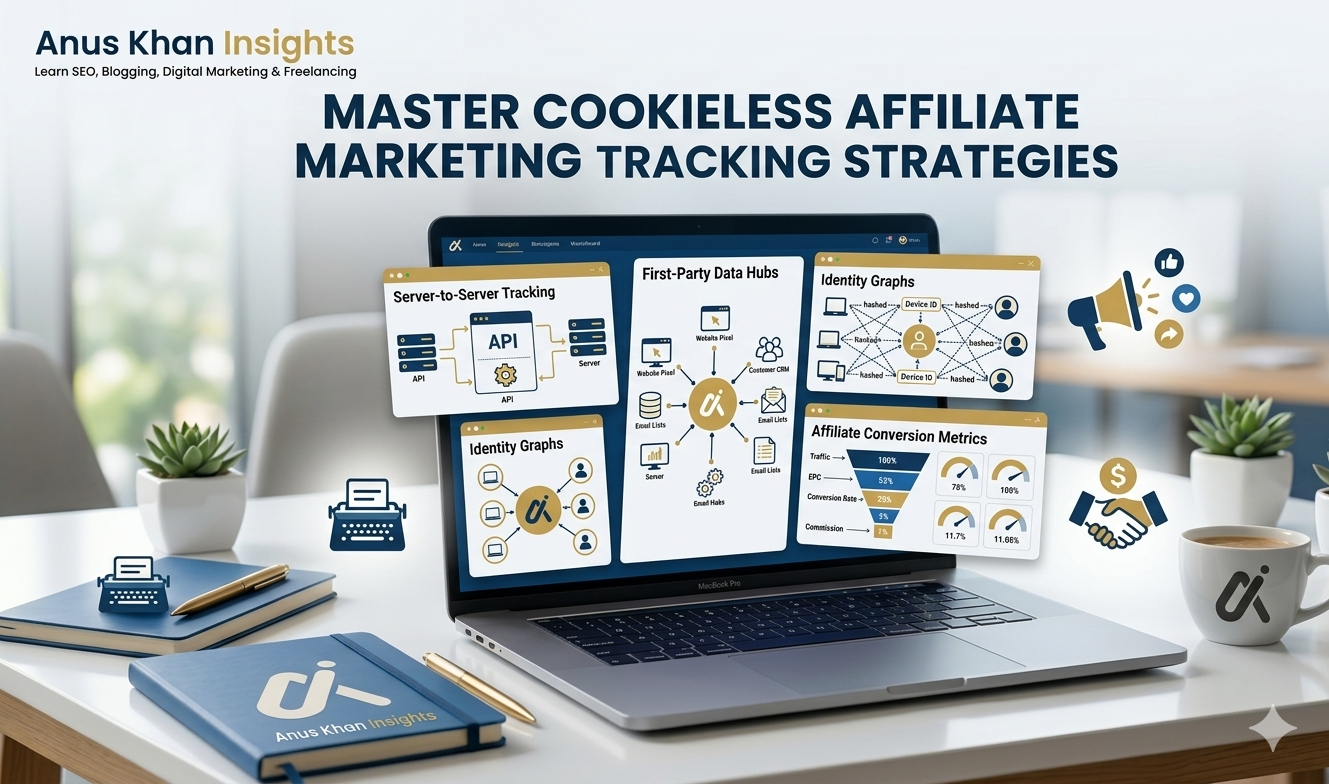
Let’s be completely honest—the digital marketing space loves dropping sudden surprises on us, and the total elimination of third-party browser cookies is easily the biggest shake-up for affiliates in years. If your online revenue relies on affiliate partnerships, you are probably wondering how on earth conversions will be tracked going forward. To safeguard your passive income and keep your revenue charts climbing, it is officially time to master cookieless affiliate marketing tracking strategies. At Anus Khan Insights, we make it our core mission to guide you through these major industry shifts long before they disrupt your day-to-day business. As a platform Owner, adapting to this privacy-first ecosystem is your definitive blueprint for long-term growth. Let’s break down the new tracking landscape in a clear, friendly way.
1. Server-to-Server (S2S) Tracking: The Power of Direct Connection
In the old days, when a reader clicked your affiliate link, a small tracking cookie was dropped into their web browser to monitor the sale. Now that modern browsers are blocking those tracking pixels, we have to bypass the browser altogether using Server-to-Server (S2S) tracking, often called postback tracking.
Here is how it works: the moment a user clicks your link, your server automatically passes a unique Click ID straight to the affiliate network’s server. When a purchase occurs, the merchant’s server tells the network’s server directly, “Hey, this specific ID just bought something.” Because the browser is completely left out of the loop, your conversion tracking stays 100% accurate, safe, and secure from browser ad-blockers.
2. First-Party Data Hubs: Owning Your Audience Relationship
When relying on third-party tracking tools fails, your own internal data assets become your greatest superpower. The future of high-earning affiliate marketing belongs entirely to creators who own their direct audience relationships.
Focus heavily on building interactive elements on your site, such as custom quizzes, helpful calculators, or high-value newsletters. When readers gladly share their preferences and email addresses with you, you establish a direct identity network. This allows you to recommend the perfect affiliate solutions based on real, first-party data without ever needing a sneaky tracking cookie to guess what they like. At Anus Khan Insights, we emphasize that a clean subscriber list is your most valuable asset.
3. Contextual Commerce: Right Content, Right Product
For years, generic affiliate platforms stalked users across the web, showing them ads based on random things they looked at days ago. That model is broken. The future is all about Contextual Commerce—matching your affiliate offers strictly to the exact topic on the screen.
If a reader is currently engaging with a deep-dive guide on professional tech setups, your affiliate recommendations within that text should feel like a natural extension of the article itself. When your product placement is hyper-relevant and seamlessly integrated into friendly, authoritative content, users don’t need to be tracked across the web to buy. They click and convert because they genuinely trust the layout in front of them.
4. Cross-Device Identity Graphs and Digital Wallets
Today’s consumer behavior is highly non-linear. A reader might discover your article on their smartphone during breakfast, compare options on their work laptop, and finally complete the checkout on an iPad at night. Traditional cookies immediately lose track of this journey.
To fix this, modern affiliate programs are adopting advanced, privacy-compliant Identity Graphs to securely link user actions across multiple devices. Furthermore, integrations with browser-level digital wallets ensure that, as long as a user is securely logged into an ecosystem, your hard-earned affiliate commission is correctly attributed to your platform.
Conclusion
The death of the cookie isn’t the end of affiliate marketing; it is simply the start of a much cleaner, more transparent era that respects user privacy while eliminating fraud. When you proactively master cookieless affiliate marketing tracking strategies, you transition your business into a far more stable setup. As an expert digital strategist, your focus should always be on future-proofing your infrastructure. Align your platform with S2S systems, prioritize your first-party data here at Anus Khan Insights, and keep your monetization engine running smoothly.


Leave a Reply