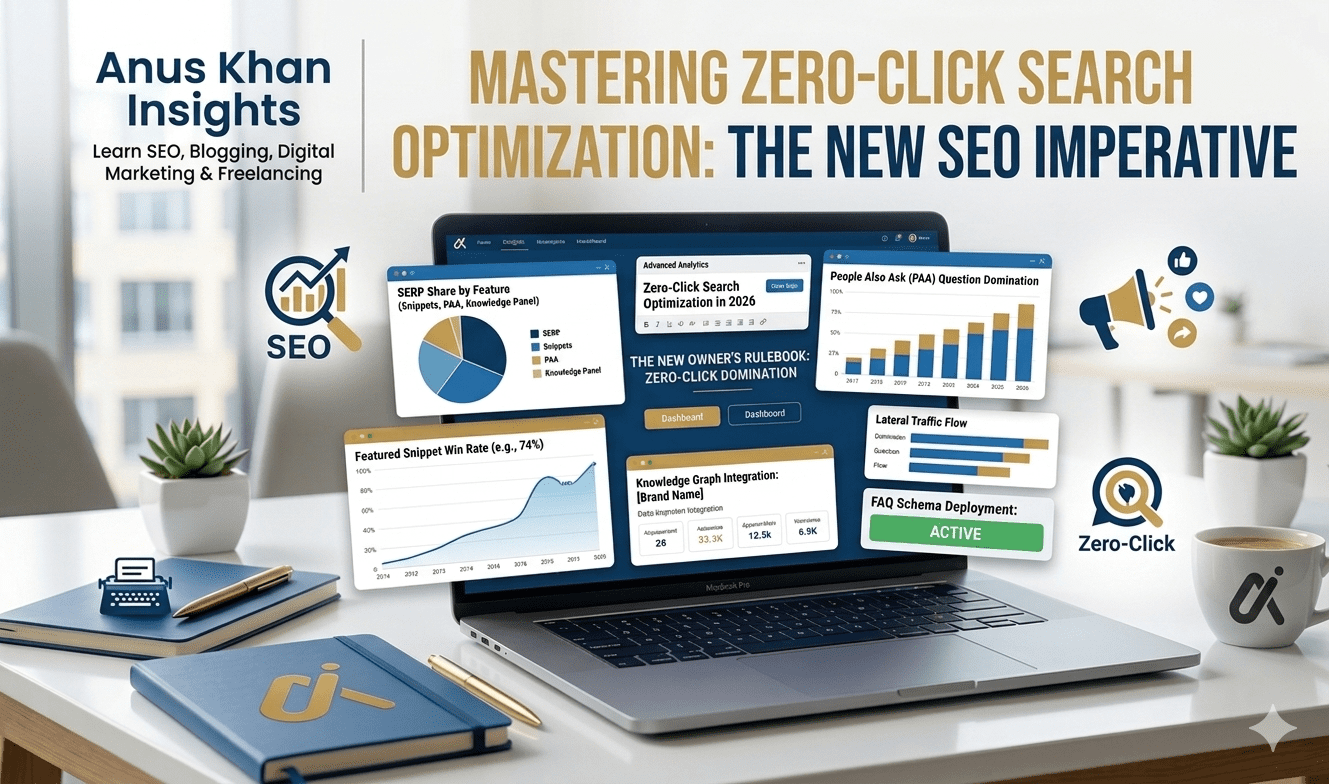
Let’s be completely honest: when was the last time you looked up a quick fact on Google and actually clicked through to a website? Chances are, you found the answer displayed right at the top of the search results page and went about your day. While this might initially sound like terrifying news for organic web traffic, learning exactly how to master zero-click search optimization in 2026 is actually your absolute biggest opportunity to dominate the modern digital landscape. At Anus Khan Insights, we believe that shifting search algorithms shouldn’t scare you—they should inspire you to build a highly visible, deeply authoritative brand. As a platform Owner, transforming these zero-click landscapes into massive brand impressions is the ultimate rulebook for future-proofing your organic reach. Let’s break down this new ecosystem in an engaging, reader-friendly way.
1. Decoding the Zero-Click Phenomenon
To put it simply, a zero-click search happens when Google addresses a user’s query directly on the Search Engine Results Page (SERP) via Featured Snippets, Knowledge Panels, or ‘People Also Ask’ boxes. The user gets exactly what they need without clicking a single external link.
At first glance, this feels like lost traffic. But as a business owner, shifting your perspective changes the entire game. When Google pulls your content into that coveted top snippet, it is publicly certifying your website as the definitive, trusted authority on the subject. When users repeatedly see your brand name anchoring the answers to their industry questions, deep brand trust is built. The next time they have a complex problem that requires a deep click, your site is the only destination they will choose.
2. Structuring Content to Snag Featured Snippets
Google doesn’t just pick snippets at random; it actively scans for content that is structured to answer questions efficiently. Algorithms favor text that cuts straight through the noise.
The 40-60 Word Answer Block: Directly under a main heading, summarize the answer to the target question in a concise paragraph of about 40 to 60 words. Google frequently lifts these exact blocks for paragraph snippets.
Clean Bulleted Lists and Data Tables: If a query covers a process, a set of steps, or comparative data, organize it into a clean list or markdown table. Crawlers love structured formatting because it is incredibly easy to parse and display on the SERP.
Strategic Bold Emphases: Bold your primary technical terms and direct answers. This provides immediate visual signals to both automated search bots and human readers flipping through your page.
3. Dominating the ‘People Also Ask’ (PAA) Ecosystem
Google’s ‘People Also Ask’ section is an absolute goldmine for building lateral authority. Because these accordion boxes expand infinitely as users click them, conquering this real estate keeps your brand visible across hundreds of related search paths.
To land inside PAA boxes, systematically map out conversational, long-tail questions connected to your core topic. Turn these questions into clear subheadings (H3 or H4 tags) throughout your article. Follow each subheading immediately with a friendly, direct answer. This organized approach makes it incredibly simple for Google to segment your article and pull individual answers into relevant PAA queries.
4. Deploying Advanced Schema Architecture
Technical precision is what seals your visibility behind the scenes. To win the zero-click race, you must give search engines explicit, machine-readable instructions that map out your content’s exact context.
Custom FAQPage Schema: Implement a customized, nested JSON-LD FAQ schema directly into your code. This tells search bots exactly which lines constitute a question and which lines represent the definitive answer, maximizing your eligibility for rich search features.
Explicit Entity Linking: Use your structured data to link core concepts in your text back to established global authority nodes like Wikidata or Wikipedia URLs. This structural clarity anchors your content directly onto the global web of data, allowing AI engines to categorize your brand’s authority seamlessly.
5. Maximizing Click-Through Rates (CTR) When It Matters Most
While visibility is incredible, some of your content is built for deep reading, where a click is absolutely vital. For those high-value assets, your optimization strategy must shift toward creating compelling entry points.
Craft headlines that pique curiosity without resorting to cheap clickbait, staying strictly within optimal character limits. Design your meta descriptions to serve as a high-converting teaser rather than a complete summary. By giving the reader a taste of the unique, premium value waiting for them inside the article, you create an irresistible urge to click through.
Conclusion
Zero-click search isn’t a threat to modern SEO; it is a beautiful evolution toward a more helpful, responsive internet. When you actively choose to master zero-click search optimization in 2026, you align your platform perfectly with where search engines are going. You transition your site from a basic blog into an interconnected digital authority hub. Apply these entity-focused schemas, structure your answers cleanly, and deliver them all with the human touch we champion here at Anus Khan Insights. The visibility you build today ensures your business’s unshakeable digital growth tomorrow.
Leave a Reply