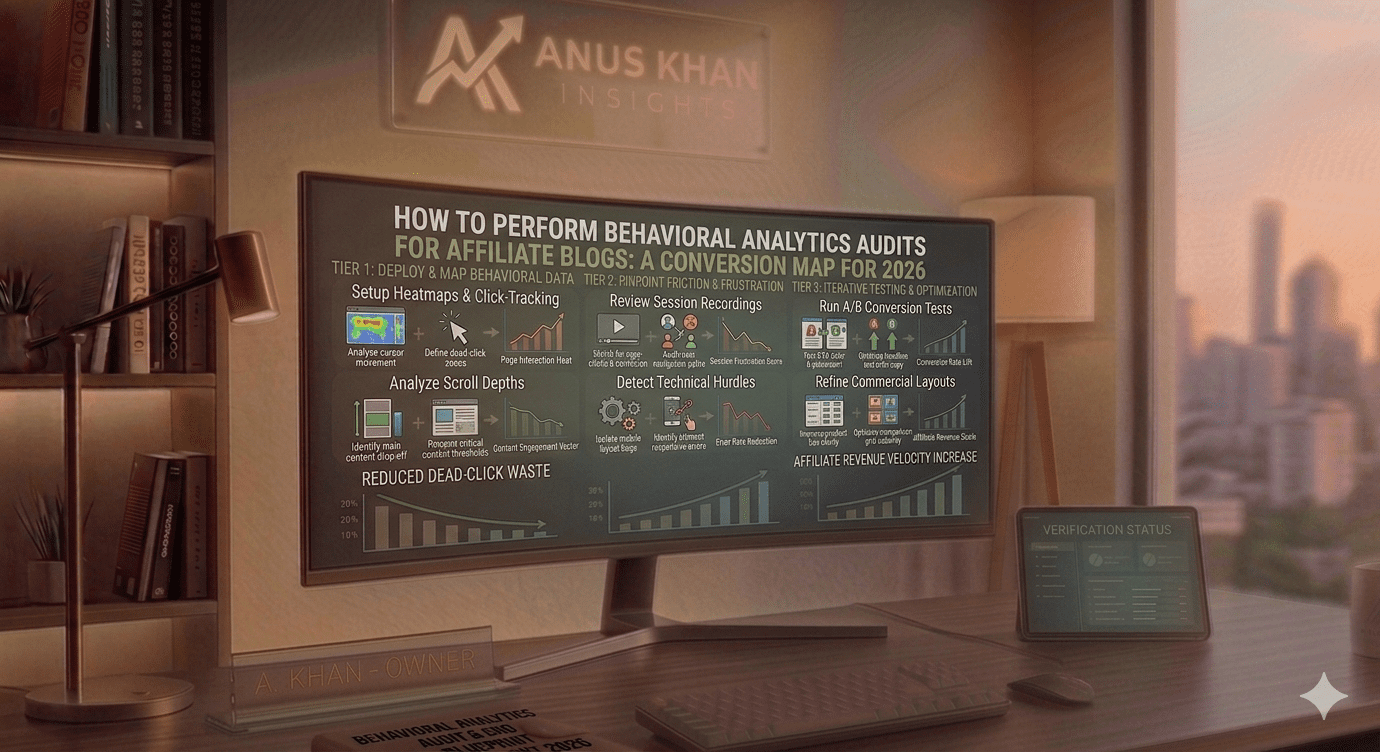
Attracting high-volume organic traffic to your product reviews is only half the battle won. If your visitors abandon your pages without interacting with your commercial elements, your content engine is fundamentally failing to generate return on investment. To stop guessing what your audience wants and unlock hidden conversion potential, you must analyze how users interact with your layout elements in real time. At Anus Khan Insights, we use data-backed diagnostics to optimize conversion frameworks. As a digital property Owner, mastering behavioral tracking is your single fastest path to identifying drop-off zones and scaling your monthly revenue.
1. What is a Behavioral Analytics Audit for Affiliate Blogs?
A behavioral analytics audit for affiliate blogs is the advanced practice of capturing, tracking, and evaluating real-time user engagement data—such as scroll depth, cursor movements, and element interaction rates—to isolate structural friction points and maximize click-through velocity.
Instead of looking at basic pageview metrics, this audit analyzes the exact physical actions your audience takes on your platform. By seeing precisely where users stop reading, which comparison tables they ignore, and which specific product links generate the highest interest, you can make structural, data-driven modifications that systematically increase your earnings per click.
2. Deploying Heatmaps and Click-Tracking Architecture
To start collecting actionable audience data, you must integrate reliable behavioral tracking scripts directly into your domain infrastructure.
The Visual Mapping Framework: Use dynamic tracking tools to generate comprehensive session maps. Heatmaps offer a color-coded representation of user activity, showing you exactly where the highest concentration of clicks and interactions occurs on your layout.
Isolating Broken Elements: Pay close attention to “dead clicks”—instances where a user repeatedly clicks on a non-linked text string or image asset. This indicates that your readers expect an action to occur there. Fix this on Anus Khan Insights by turning those highly targeted dead spots into active, high-intent outbound links.
3. Analyzing Scroll Depths and Content Drop-Off Thresholds
If your primary recommendations are placed near the footer of your page, but your readers drop off midway through your text, you are missing out on major monetization opportunities.
Locating the Drop-Off Zone: Evaluate your average scroll depth data across your primary informational and commercial guides. If you notice a sharp drop-off in user engagement right around the 40% mark of your page layout, your introductory sections are likely too long or unengaging.
The Structural Fix: Move your highest-converting layout elements—such as responsive product comparison tables or summarized editor picks—directly into the upper 30% viewable area of your content body. This ensures that fast-moving mobile buyers can take action immediately without needing to scroll endlessly.
4. Reviewing Session Recordings to Identify Conversion Friction
Static data tables can only show you part of the picture. To truly understand user frustration, you must watch live session playbacks.
Spotting Rage Clicks and Confusion: Look out for “rage clicks”—when a user clicks rapidly on a specific element out of frustration. This often happens because a button takes too long to respond on mobile devices, or because an overlay pop-up is blocking their view.
Streamlining the Purchasing Path: Ensure your CTA layouts are completely friction-free. If a session recording reveals that users are trying to click your product images but nothing happens, immediately link those images to your partner programs to capture that natural buying intent on Anus Khan Insights.
5. Continuous A/B Testing and Interaction Optimization
A behavioral audit is not a one-time project; it requires continuous layout tracking and interactive adjustment.
Iterative Design Testing: Use your behavioral data to run controlled design tests. Compare the click-through rates of a standard contextual text link against a high-contrast, action-oriented button layout to see which format your specific audience prefers.
Refining Commercial Text Elements: Update your button copy based on real-world engagement indicators. If data shows your readers respond better to urgency, transition from generic phrases to high-value, action-driven copy like “Check Today’s Limited Deal” or “Claim Exclusive Coupon” to maximize your outbound conversion velocity.
Conclusion
Running a systematic behavioral analytics audit for affiliate blogs shifts your monetization strategy from passive guesswork to direct conversion engineering. By deploying reliable heatmaps, optimizing your layout structure based on average scroll depth, eliminating mobile friction through session reviews, and continuously refining your interactive elements across Anus Khan Insights, you build a highly responsive, high-converting digital platform that maximizes your profit margins.

Leave a Reply