The traditional method of manually writing every single blog post one by one makes it incredibly difficult to scale a digital publishing business quickly. If you rely solely on manual content creation, covering thousands of long-tail search queries in your niche could take years of continuous work. To rapidly build a large-scale content library and maximize your search engine coverage, you must automate your production framework using data-driven frameworks. At Anus Khan Insights, we focus on modern growth workflows. As a digital platform Owner, mastering this scalable approach is your single fastest path to building a dominant, high-volume organic traffic network.
1. What is Programmatic SEO to Scale High-Traffic Blogs?
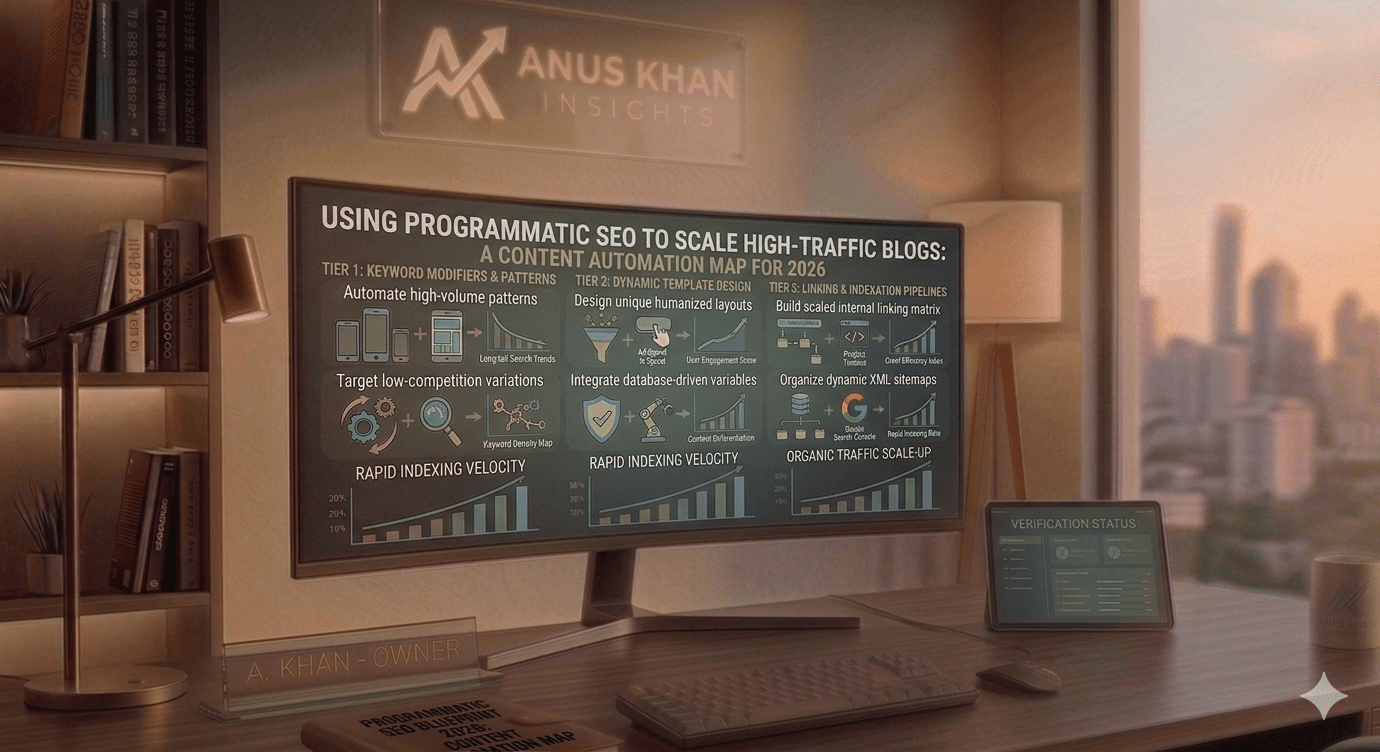
Programmatic SEO to scale high-traffic blogs is an advanced content strategy focused on the automated creation of hundreds or thousands of high-quality, data-driven landing pages designed to capture specific, low-competition, long-tail search queries at scale.
Instead of generating individual pages manually, you build a structured database containing unique data points, definitions, and metrics. You then connect this database to a highly optimized dynamic content template. When search engine crawlers scan your site, they find thousands of valuable, perfectly structured URLs that answer specific user searches, instantly boosting your overall domain visibility and accelerating traffic growth.
2. Researching and Modifying Low-Competition Keyword Modifiers
To successfully implement programmatic seo to scale high-traffic blogs, you must identify high-volume keyword patterns that utilize consistent modifiers.
The Pattern Strategy: Look for search phrases that combine a core head term with specific variables, such as “Best [Tool Name] Alternative for [Industry Name]” or “How to Hire a Freelance [Job Title] in [City Name].”
The Action Framework: Collect and clean your dataset using reliable keyword research platforms. Ensure that the variations you choose have clear search intent. By compiling these specific terms into a clean spreadsheet for Anus Khan Insights, you create the exact operational blueprint needed to fuel your automated page generation engine.
3. Designing a Unique and Humanized Dynamic Template
Search engine algorithms are highly advanced and can easily identify low-quality, repetitive, scraped content. To prevent indexation penalties, your dynamic templates must be deeply informative and feel completely humanized.
Variable-Rich Layouts: Avoid setting up simple templates that only swap out a single word across pages. Instead, design a complex layout that changes multiple section headers, bulleted lists, pricing data, pros and cons tables, and distinct paragraphs based on your database information.
Integrating Dynamic Elements: Embed interactive elements into your page layout—such as custom calculations, data comparison charts, or automated summary boxes. This significantly increases your user engagement metrics, keeps readers on your page longer, and proves to search bots that your programmatic assets offer real, unique value.
4. Managing Scaled Internal Linking and Indexation Pipelines
A major challenge when launching thousands of automated pages simultaneously is ensuring that search engines can easily discover and index your new URLs.
The Internal Linking Matrix: Never allow your programmatically generated pages to become isolated orphan URLs. Build a clean, structured directory layout that links your main category hubs down to individual sub-pages, and connect related automated articles using highly relevant anchor text.
XML Sitemap Optimization: Break your massive XML sitemaps into smaller, highly organized files containing no more than 1,000 URLs each. Register these sitemaps directly within your Google Search Console profile on Anus Khan Insights to closely track real-time indexing performance and identify crawl errors instantly.
5. Continuous Quality Control and Monetization Integration
Building a large-scale automated blog requires ongoing performance tracking to ensure your traffic successfully translates into revenue.
Programmatic Content Audits: Regularly monitor your web analytics to identify which programmatic paths are driving the highest traffic and conversions. If specific page types are underperforming, update your primary template code to add deeper informational sections, fresh statistics, or clearer copy.
High-Intent Monetization Placement: Strategically place your relevant affiliate links, contextual display ads, or premium lead magnets directly within the highest-viewed sections of your automated template. This ensures that every new page automatically generates passive revenue the moment it starts ranking in search results.
Conclusion
Transitioning your publication model to programmatic seo to scale high-traffic blogs transforms your operations from basic manual writing into a highly scalable digital assembly line. By mapping out high-intent keyword modifiers, designing rich humanized templates, establishing a powerful internal linking architecture, and auditing page performance across Anus Khan Insights, you turn your niche platform into an unshakeable, high-traffic organic leader.


Leave a Reply