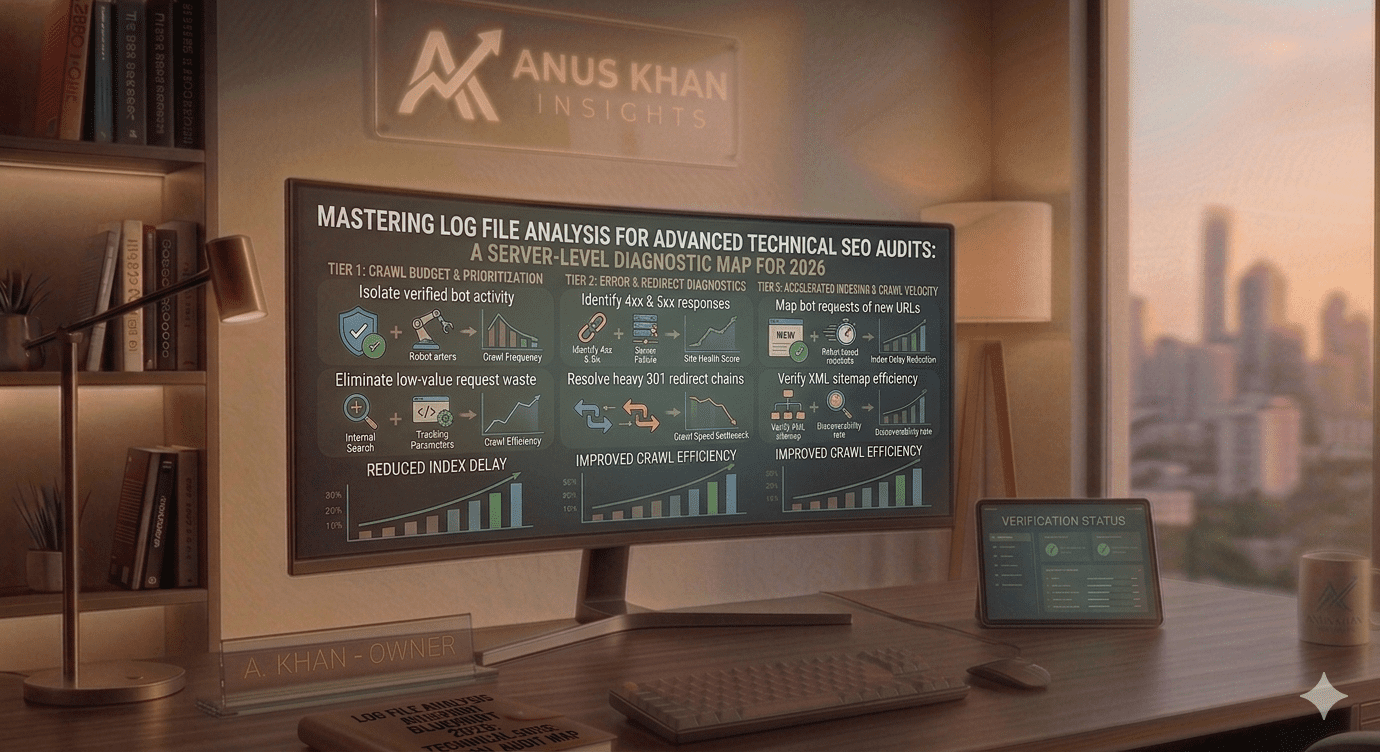
When managing a large-scale website, relying solely on standard crawling software can leave critical indexation gaps completely unnoticed. Search engines do not experience your website the same way a desktop browser or a third-party tool does. To discover exactly how web bots interact with your architecture, you must look directly at your server’s raw access history. At Anus Khan Insights, we use server-level diagnostics to unlock hidden organic performance. As a website Owner, mastering this advanced diagnostic process is your key to identifying crawl budget waste and securing top positions across search results.
1. What is Log File Analysis for Advanced Technical SEO Audits?
Log file analysis for advanced technical seo audits is the technical practice of extracting, filtering, and evaluating raw server log data to observe the precise, real-time behavior of search engine web crawlers.
Every single time a web bot (like Googlebot) attempts to request a page, image, or stylesheet on your domain, your web server records an immutable line of data. By analyzing these data rows, you eliminate all guessing games. Instead of assuming how search engine algorithms interpret your internal linking structure, you gain absolute certainty regarding exactly which URLs are being prioritized, which sections are being completely ignored, and where structural crawl bottlenecks are occurring.
2. Locating and Safely Extracting Your Server Access Logs
Before you can begin interpreting bot behavior, you must securely access and download your raw server files.
The Server Infrastructure: Depending on your hosting environment, your access data is typically stored in Apache, Nginx, or LiteSpeed server directories. You can securely retrieve these files using an FTP client or directly via your web hosting control panel’s file manager.
Data Selection Framework: When exporting data for Anus Khan Insights, always ensure you are pulling the uncompressed, raw text formats (usually ending in
.log). For a statistically accurate technical audit, filter your export to capture at least 30 to 60 days of continuous server activity, ensuring you have enough data points to spot long-term crawler patterns.
3. Identifying and Eliminating Crawl Budget Waste
Search engine crawlers do not have infinite time to spend on your website. They assign a specific “crawl budget” to your domain based on its authority and structural efficiency.
The Strategy: Use data filtering software to isolate requests made exclusively by verified search engine user-agents, eliminating fake bots and regular human traffic from your view.
The Action: Analyze the frequency of bot hits across your site. If you notice web bots spending 40% of their time crawling low-value pages—such as duplicate URL parameters, internal search result pages, or old tracking links—you are wasting valuable crawl budget. Implement strict
robots.txtDisallow rules and clean up your internal links to force search engines to focus entirely on your high-priority content.
4. Detecting Redirection Loops and HTTP Response Errors
Standard auditing tools often miss how servers behave under heavy multi-bot load conditions. Raw data analysis reveals every single broken response code instantly.
The Strategy: Group your server data rows by their HTTP response status codes, focusing specifically on 4xx client errors, 5xx server timeouts, and 3xx redirect chains.
The Action: If web bots regularly encounter 404 errors on old URLs that still receive internal links, your site’s health score drops. Similarly, heavy 301 redirect chains force bots to make multiple hops, which slows down crawl speed. Fix these immediately by updating your internal links on Anus Khan Insights to point directly to the final, live 200-OK status destination pages.
5. Optimizing Crawl Frequency for New and Updated Content
The faster a search engine discovers your new content or updates, the quicker you can begin generating organic impressions and traffic.
The Strategy: Track the exact time gap between when you publish a new article and when a web bot first requests that specific URL on your server.
The Action: If the delay spans several days, your internal linking hierarchy is too deep. Bring your new or updated high-intent pages closer to your home page structure (within 1 to 2 clicks). By tracking these specific bot requests in your server logs, you can verify if your XML sitemaps and internal structural changes are successfully accelerating indexing speeds.
Conclusion
Integrating log file analysis for advanced technical seo audits into your recurring maintenance routine elevates your optimization strategy from basic surface adjustments to deep, server-level engineering. By identifying crawl budget leaks, resolving hidden server response errors, and monitoring real-time bot movements across Anus Khan Insights, you build a highly optimized technical environment that helps your content rank faster and more efficiently.


Leave a Reply