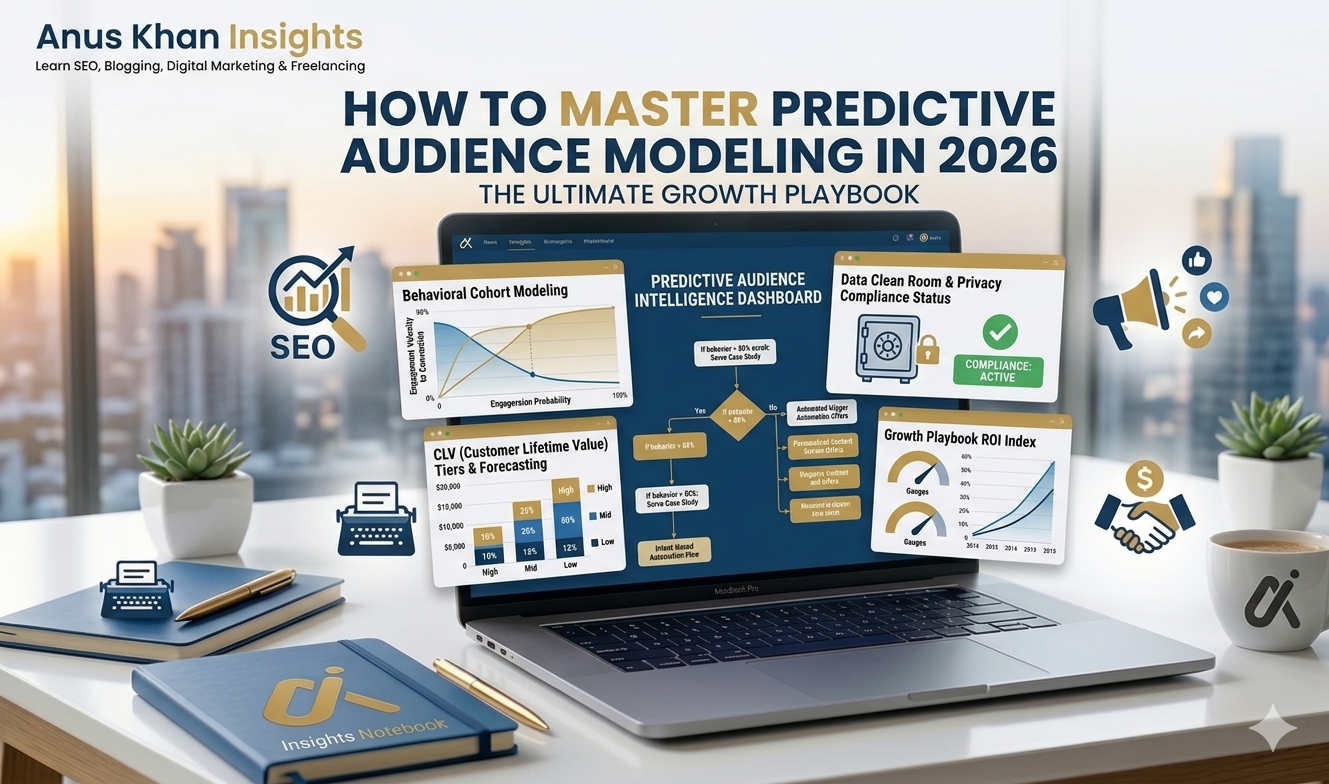
Have you ever wished you had a digital crystal ball to tell you exactly what your customers are going to buy before they even add it to their cart? In the hyper-fast digital space of today, relying on old marketing metrics to guess your audience’s next move is a quick way to burn through your ad budget. If you want to scale your campaigns efficiently and maximize your revenue, it is officially time to master predictive audience modeling in 2026. At Anus Khan Insights, we consistently preach that modern market leaders do not just react to historical data—they actively anticipate future consumer behaviors using machine learning. As a platform Owner, moving from reactive tracking to predictive data forecasting is your definitive playbook for building an unstoppable competitive advantage. Let’s break down this cutting-edge marketing paradigm in a simple, friendly way.
1. Decoding Predictive Audience Modeling
To put it simply, predictive audience modeling uses advanced machine learning algorithms to scan your first-party data, identify deep historical patterns, and accurately forecast how your users will behave in the future. Instead of looking back at last month’s conversion rates, you are looking forward to seeing who is most likely to buy, churn, or upgrade next week.
By shifting your focus here, you stop wasting marketing resources on cold or uninterested audiences. Instead, your systems flag high-intent users early in their digital journey, allowing you to allocate your marketing budget with absolute algorithmic precision.
2. Forecasting Customer Lifetime Value (CLV) Early
Not all traffic is created equal. A common mistake for many digital platforms is treating every single click or sign-up with the same weight. Predictive analytics completely changes this by calculating a user’s projected long-term value within their first few days of interaction.
Behavioral Cohort Tagging: Algorithms analyze micro-behaviors—such as specific page-scroll depths, newsletter interaction frequencies, and initial resource downloads—to instantly assign users to predictive value tiers.
High-Value Budget Allocation: By identifying your highest-value cohorts early, you can aggressively scale your retargeting efforts toward the segments guaranteed to bring the highest return on investment (ROI), while pulling back on low-converting demographics.
3. Activating Intent-Based Automated Personalization
Static marketing automation funnels that treat every user step-by-step are no longer effective. Today’s consumer expects your platform to dynamically adapt to their mood, intent, and exact stage of readiness.
When you implement predictive tracking architectures, your marketing system triggers highly tailored product recommendations or dynamic offers right before a user consciously realizes they are ready to convert. If a predictive model detects a sudden velocity change in an enterprise reader’s interaction pattern, it can instantly serve a hyper-relevant B2B case study or a custom software discount, closing the conversion loop effortlessly.
4. Privacy-Safe Machine Learning and Data Clean Rooms
With user privacy regulations tighter than ever in 2026, building these advanced tracking models requires a massive shift away from legacy pixels and third-party data collection. Security and machine precision must walk hand in hand.
Utilize encrypted Data Clean Rooms to safely match your aggregated user datasets with trusted ad networks without exposing sensitive personal identifiers. By training your predictive models strictly on clean, server-side first-party data assets, you guarantee that your digital infrastructure remains completely future-proof, highly secure, and fully compliant with global privacy mandates.
Conclusion
Predictive marketing isn’t a futuristic luxury; it is the fundamental baseline for modern business scalability. When you commit to master predictive audience modeling in 2026, you fundamentally change how your business operates. You stop guessing what your market wants and start building data structures that respond to user needs ahead of time. Anchor your automation frameworks around clean first-party data graphs, prioritize high-value consumer cohorts here at Anus Khan Insights, and watch your digital marketing efficiency scale to unprecedented heights.
Leave a Reply